
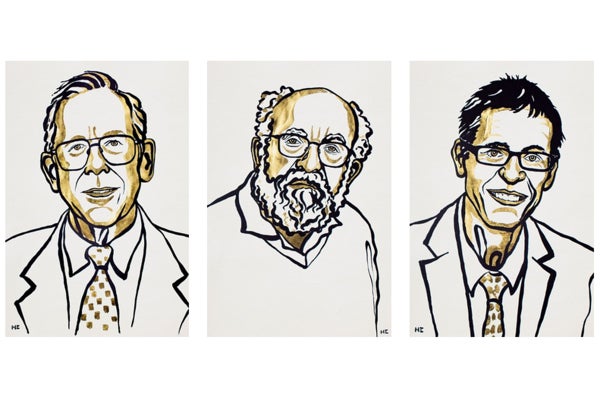
Discoveries on the grandest scale in the cosmos, as well as findings a bit closer to home, share this year’s Nobel Prize in Physics. Cosmologist James Peebles of Princeton University won half the award for helping to build our picture of how the universe formed and evolved. And the other half went to Michel Mayor of the University of Geneva and Didier Queloz of the University of Cambridge and the University of Geneva for finding 51 Pegasi b, the first exoplanet orbiting a sunlike star.
Together, the winners “have painted a picture of a universe far stranger and more wonderful than we ever could have imagined,” said Nobel Committee member Ulf Danielsson, a physicist at Uppsala University in Sweden, in a press conference. “Our view of our place in our universe will never be the same again.”
On supporting science journalism
If you're enjoying this article, consider supporting our award-winning journalism by subscribing. By purchasing a subscription you are helping to ensure the future of impactful stories about the discoveries and ideas shaping our world today.
Peebles helped predict the cosmic microwave background radiation—the first light in the universe, which allows scientists to trace the earliest epochs in the cosmos. Over a half-century career he has shaped our view of how the big bang created matter, how galaxies formed and what makes up the missing bulk of the universe—the unknown entities of dark matter and dark energy. “Isn’t it fascinating,” Peebles said this morning during a Nobel announcement interview, “that we have very clear evidence that our universe did expand from a hot, dense state, but although the theory is very thoroughly tested, we still must admit that the dark matter and dark energy are mysterious?”
The other side of the prize this year honors one of the pioneering discoveries in exoplanet science: the 1995 revelation of 51 Pegasi b. Mayor and Queloz carefully measured a star’s velocity, finding that it wobbles back and forth in a telltale pattern produced by the gravitational pull of an orbiting planet.
Before this finding, the only confirmed exoplanet known orbited a pulsar—a dense remnant from a supernova explosion. The world 51 Pegasi b, on the other hand, orbits a “main sequence” star, the same category as our sun, about 50 light-years from Earth. It was the prototype “hot Jupiter”—a massive gas giant around the size of the solar system’s largest planet (in this case about half the mass of our own Jupiter) in a bizarrely short orbit extremely close to its star. The planet has a year only four days long. “Few had expected that such planets could exist,” Danielsson said. “We had thought that other solar systems would be similar to our own. We were wrong!” The discovery launched a race that has now racked up more than 4,000 known planets orbiting other stars.
“I cannot be happier about the choice of these year’s recipients,” says astrophysicist and author Mario Livio. “On one hand, the discoveries in cosmology showed that our physical existence is tiny in the grand scheme of things. On the other, the Earth is, so far, the only place where we know that life exists. In some sense, the question of whether there is life (and especially complex life) elsewhere may be the most exciting question in science today.”
“It’s a great day for exoplanets,” says Sara Seager, a pioneer in exoplanet studies. “To see a field go from obscure, fringe and laughable to Nobel-worthy is a huge tribute to people all around the world making exoplanets real. In exoplanets, the line between what is considered completely crazy and what is considered mainstream science is constantly shifting. The Nobel award is a cataclysmic shift in the right direction.”