
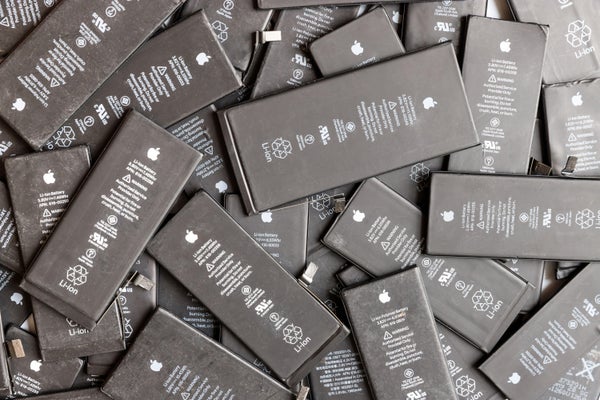
Grinding up old batteries might lead to a low-energy way to recycle the lithium and other metals used in them.
Lithum-ion batteries are in all our personal technology — such as phones, laptops and wireless headphones — and they power electric vehicles. Without them, our lives would look very different.
The lithium in rechargeable batteries is currently recycled by either heating them to high temperatures or treating them with concentrated acids and organic solvents. Estimates for how much lithium is recycled vary, but calculations by lithium-battery consultant Hans Eric Melin suggest that perhaps 15% of the metal in batteries is recovered.
On supporting science journalism
If you're enjoying this article, consider supporting our award-winning journalism by subscribing. By purchasing a subscription you are helping to ensure the future of impactful stories about the discoveries and ideas shaping our world today.
Oleksandr Dolotko, a materials scientist at Karlsruhe Institute of Technology, Germany, and his colleagues used mechanochemistry — the initiation of a chemical reaction by mechanical force from grinding or milling — to recover lithium from lithium-ion batteries.
Such batteries contain lithium compounds and other metals, such as cobalt or nickel. Although the supply of these metals is not critically running low, recycling them is becoming more important because battery-powered devices are becoming more prevalent as part of the transition away from fossil-fuel energy. The European Union has set a target of 80% lithium recovery for all batteries by 2031.
Dolotko’s team developed two extraction methods, with varying success. They first took the cathode material from a lithium cobalt oxide battery and combined it with the same amount of aluminium foil. Real-life batteries contain aluminium, which they use as a ‘current collector’ to allow electrons to move out of the battery. The researchers mixed the compounds using a grinder called a ball miller. After 3 hours, the aluminium had reacted with the cathode material and produced a mixture of insoluble aluminium oxides, as well as metallic cobalt and water-soluble lithium oxides.
A separation method known as water-based leaching and further purification produced the recycled lithium compound: lithium carbonate, which can be used to make more batteries.
But these reactions recovered only 30% of the metal. “Somewhere there was a loss of lithium,” says Dolotko. So Dolotko’s team tweaked their experiment. The second version had fewer steps — they heated the mixture that came out of the ball milling with water. This prevented the formation of insoluble lithium aluminium oxides, which lock up the lithium.
The team tested both processes with different cathode materials used in batteries, as well as a mixture of the cathodes. The improved process recovered 75% of the lithium from a mix of cathode materials.
Mechanochemistry is not typically used in commercial chemical processes, and exactly how mechanical force initiates chemical reactions isn’t completely understood, says Dolotko. “It is really hard to say how it happens,” he says. Perhaps the temperature increases at specific points in the process, or friction produces some intermediate products, he suggests. But the milling did prompt the aluminium to act as a reducing agent, as he expected.
This mechanochemical recycling process is a demonstration, at the scale of a small laboratory, and as such is a proof of principle rather than a game-changing technology, says Melin, director of Circular Energy Storage, a London-based consultancy focused on the lithium-ion-battery end-of-life market. He points out that battery recycling is more complicated than simply developing a new technique, and is as much about the economics of the raw materials and the take-up of technologies that use batteries, such as electric vehicles.
“We are in a situation where we don’t really know today where the lithium we need in 2030 will come from,” Melin says.
Dolotko says that there are opportunities to refine the process, and he is also working to extract other metals from batteries at the same time, including cobalt and nickel.
This article is reproduced with permission and was first published on March 29, 2022.