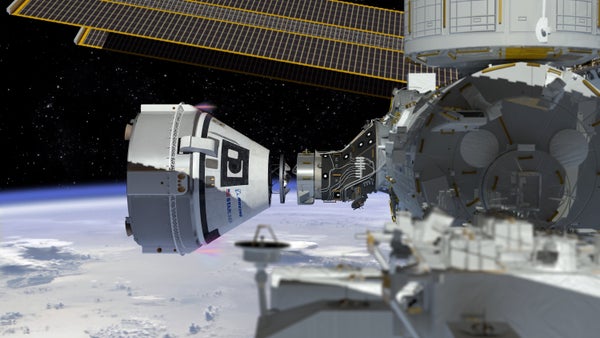
This artist's concept shows Boeing’s CST-100 Starliner spacecraft, currently under development for NASA’s Commercial Crew Program, docking to the International Space Station.
If you're enjoying this article, consider supporting our award-winning journalism by subscribing. By purchasing a subscription you are helping to ensure the future of impactful stories about the discoveries and ideas shaping our world today.
Editor’s Note (4/22/20): On April 17 an official launch date of May 27 was announced for the historic first crewed test flight of SpaceX’s Crew Dragon spacecraft. The craft is set to carry two astronauts to the International Space Station and back.
When the space shuttle Atlantis landed and rolled to a stop at Florida's Kennedy Space Center in 2011, bringing the 30-year shuttle program to a close, NASA hoped to fly U.S. astronauts onboard privately developed space taxis within four years. But budget shortfalls added two years to development schedules, and then technical problems with parachutes and launch escape systems pushed key flight tests to 2019. Now SpaceX—the company selected along with Boeing in 2014 to fly crews to and from the International Space Station—is finally on the cusp of launching two NASA astronauts on a long-awaited trial run. Boeing plans to follow, possibly this year, although the company ran into software glitches during its uncrewed test flight last December. Here's a look at the ups and downs of NASA's decade-long effort to restore human orbital spaceflight in the U.S.
Credit: NASA ( 1 and 2 ); SPACE X ( 3, 8 and 9 ); AEROJET ROCKETDYNE ( 4 ); NASA’S JOHNSON SPACE CENTER ( 5 ); NASA’S JOHNSON SPACE CENTER AND BOEING ( 6 ); BILL INGALLS AND NASA ( 7 )
Subscribe to Support Independent Journalism
Great science journalism requires human expertise, time, effort and creativity. And it costs money. That’s why I and the journalists here at Scientific American hope you’ll join our community.
When you subscribe, you are supporting staff and freelance journalists who are passionate about telling science stories that are true, important and compelling. Our editors and reporters are often experts in their fields, which means they understand the nuances of big discoveries and can untangle the breakthroughs from the hype. With a subscription, you are also supporting rigorous fact-checking to ensure the words we publish are precise and accurate. And you’re supporting original illustrations, graphics and photos that bring you closer to an advanced laboratory, an ice sheet in Antarctica or a space mission in orbit. You’re helping us craft other types of high-quality journalism as well: Our newsletters are carefully written, edited and curated by staffers you have or will come to know and love. Our Science Quickly podcast is based on original reporting, collaboration with editors and scientists and exacting production.
Subscriptions keep this engine running so we can continue to deliver thoughtful, rigorous and independent science journalism to you. In an era of viral misinformation, this work is crucial. If you value what we do, I hope you’ll consider joining us as a subscriber
Thank you,
Jeanna Bryner, Editor in Chief, Scientific American