
The day that Joe Biden takes the oath of office as president of the U.S. will also mark another, less auspicious milestone. It was on the same day a year earlier that the nation’s first known COVID case was diagnosed in Washington State.
January 20, 2020, set off a public health crisis that extended its reach to every U.S. citizen—and ultimately every member of the human species. The U.S. death toll reached more than 370,000 by January 9, 2021—a number greater than the population of Honolulu and nearly as big as that of Cleveland. The pandemic has resulted in more American deaths than any U.S. conflict except for the Civil War and World War II—and it is on a course to surpass the latter’s losses.
The country saw a new record of more than 4,000 daily deaths caused by COVID-19 on January 7, according to the Centers for Disease Control and Prevention. The alarming figure indicates that the disease is likely to become the country’s deadliest killer this winter.
On supporting science journalism
If you're enjoying this article, consider supporting our award-winning journalism by subscribing. By purchasing a subscription you are helping to ensure the future of impactful stories about the discoveries and ideas shaping our world today.
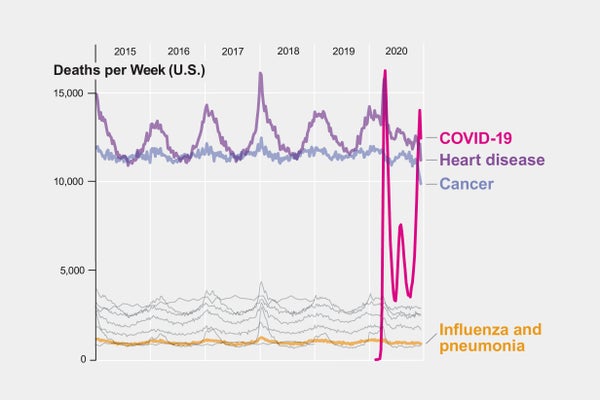
Heart disease and cancer are the two leading causes of mortality at normal times. In the month of January, the U.S. usually has about 2,300 daily deaths from heart disease and 2,000 from cancer—averages tallied from CDC data for 2015–2020. Meanwhile the daily deaths caused by COVID-19 averaged more than 3,200 in the past week. If historical data are reliable, the illness has most likely become the leading cause of death in the U.S. in the ongoing surge.
This is not the first time COVID-19 has turned into the number-one killer since the start of the pandemic a year ago. The CDC’s weekly mortality data, derived from death certificate filings, showCOVID-19 became the third-biggest cause of deaths in the week of March 30 to April 4 last year, trailing heart disease and cancer. A spike in the week-by-week accounting came in mid-April, when COVID-19 cases were the leading cause of death for two weeks.
The disease returned to the third-deadliest spot in the week of May 3 to 9. Then, after a summer decline, the numbers shot up. It was the leading cause of mortality again in the last week of November 2020. And COVID-19 stayed there for at least two more weeks, killing more people than heart disease, cancer, stroke, chronic lower respiratory disease, Alzheimer’s, diabetes, kidney disease or influenza. Incomplete December 2020 data reported so far indicatethat close to 35,000 people died of the illness caused by the coronavirus over the course of that month.The flu, which President Donald Trump and others have invoked when attempting to downplay COVID-19, led to about 2,600 deaths (a figure that includes pneumonia) over the same time frame. As tallies for 2020 are finalized at the CDC, it appears that COVID-19 trailed behind only heart disease and cancer as a cause of mortality during all of 2020.
This profile of loss can be broadened further to measure excess deaths above typical mortality rates. Estimates from the CDC show that nearly 300,000 more people died during the first nine months of 2020 than would be expected in the same nine-month intervals from 2015 to 2019. COVID-19 was estimated to account for two thirds of those additional deaths.
Such trend lines for the pandemic are likely to continue for at least a few months to come. The Institute for Health Metrics and Evaluation at the University of Washington projects that by April 1 this year, COVID-19 may be responsible for the deaths of more than 560,000 people in the U.S.—a figure that represents 84 percent of the total number of people who died in the country during the 1918 flu pandemic. A recent Viewpoint piece in JAMA repeats a common mantra of how the U.S. must respond. “The prospect of a vaccine offers hope for 2021, but that solution will not come soon enough to avoid catastrophic increases in COVID-19–related hospitalizations and deaths,” the article notes. “The need for the entire population to take the disease seriously—notably to wear masks and maintain social distance—could not be more urgent.”

Credit: Youyou Zhou; Sources: Centers for Disease Control and Prevention, National Center for Health Statistics
Read more about the coronavirus outbreak from Scientific Americanhere. And read coverage from our international network of magazines here.