
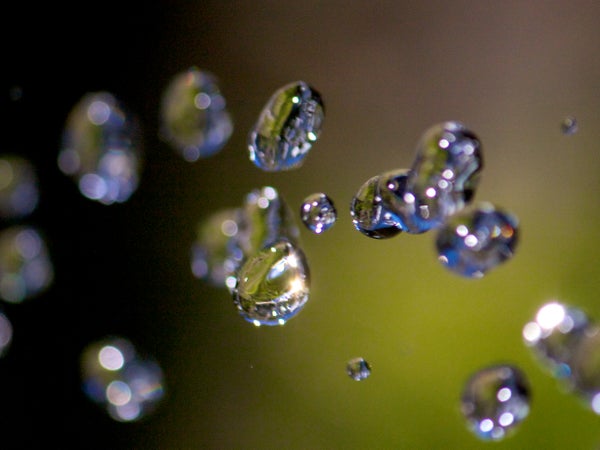
They crawl. They eat. They excrete. So you’d be forgiven for thinking these globules created by a team Japan were alive—but they’re not.
Discovering life-like motion in non-living systems fascinates Akihisa Shioi, from Doshisha University. He and his team are constantly combining new chemicals to investigate the idea.
They already knew that droplets of didodecyldimethylammonium bromide (DDAB), a cheap surfactant, react with iodide ions, then scoot around and leave chemical traces, like miniature turbo-snails. Unlike snails though, these vesicles shrank, and collapsed after a few seconds. They needed feeding. Oleic acid and calcium ions proved the missing link.
On supporting science journalism
If you're enjoying this article, consider supporting our award-winning journalism by subscribing. By purchasing a subscription you are helping to ensure the future of impactful stories about the discoveries and ideas shaping our world today.
Together, DDAB, oleate and calcium, form globules, called vesicles, with intriguing life-like movement. The vesicles crawl around on a glass slide by reacting with iodide ions, ingest smaller vesicles to maintain their size and energy, and leave behind waste; just like a living system.
Despite having an inkling that this combination of chemicals would be an interesting mix, Shioi was surprised to see the vesicles acting this way.
‘This system is the first demonstration of the potential of vesicles as hypothetical precursor compartment structures of the first cells,’ says Peter Walde, an expert in these kinds of materials at Swiss Federal Institute of Technology (ETH) in Zurich, Switzerland. He hopes scientists will explore the concepts displayed here within the context of complex chemical systems from which the first forms of life evolved.
‘Reconstructing life-like systems in the laboratory not only refers to the long-age dream of the scientist making life from non-living, but can help in understanding the principles of life from a physico-chemical perspective,’ adds Pasquale Stano, a systems chemist from Roma Tre University, Italy.
Direction control and alternative globule materials, which are biocompatible, are Shioi’s next steps for his chemical creations. Progress with these goals, could lead to exciting applications in micropatterning, drug delivery, or as scavengers to clean blood vessel walls.
However, Pier Luigi Luisi, a specialist in synthetic biology at Roma Tre University, warns that phenomena like this mechanical motion are generally ‘due to a very particular context of environmental conditions.’ Therefore, changing any aspect of the experiment could lose the particles their movement.
Shioi recently demonstrated his research to a class of children, and they were hooked. Seeing the vesicles scuttling around and gobbling up smaller ones, we all instinctively ask, as the children did, ‘Are they alive?!’
This article is reproduced with permission from Chemistry World. The article was first published on May 24, 2016.