
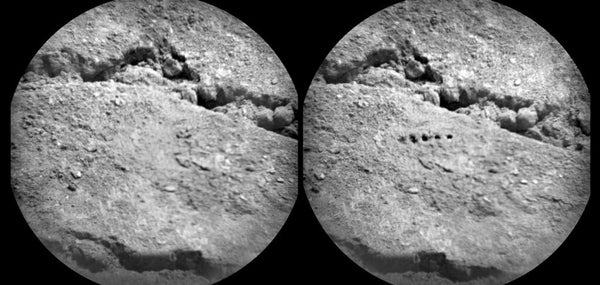
For the ChemCam on NASA’s Curiosity rover on Mars, a spot marks the spot.
ChemCam, a multitalented instrument for remotely analyzing Martian rocks and soils, fires a laser at targets up to seven meters away to determine their chemical composition. The brief laser shots pack quite a wallop—each five-nanosecond laser pulse delivers a megawatt of power, which suffices to turn a tiny region of rock or soil into glowing, ionized gas, or plasma.
ChemCam’s 110-millimeter telescope then takes in light from the laser-excited plasma and routes it to a suite of spectrometers for analysis. The spectrometers can assess the composition of the sample by parsing individual wavelengths of light in the plasma, each of which is characteristic of a different chemical element.
On supporting science journalism
If you're enjoying this article, consider supporting our award-winning journalism by subscribing. By purchasing a subscription you are helping to ensure the future of impactful stories about the discoveries and ideas shaping our world today.
Above is a before-and-after series from a ChemCam analysis of a patch of soil called Beechey. Each of the fields of view is about eight centimeters across, and the five laser-bored spots in the right image are each two to four millimeters wide. The holes were carved out by a sequence of 50 laser pulses apiece from a distance of about 3.5 meters.