
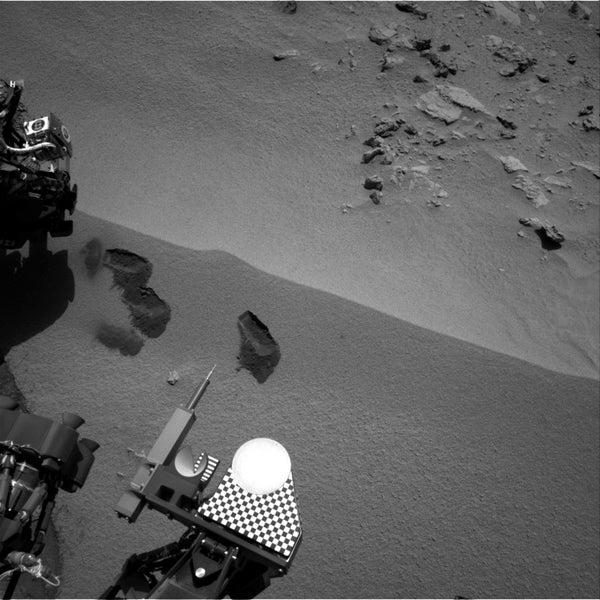
NASA's Curiosity rover is really digging in at Rocknest, a patch of Martian sand the robot has been exploring for more than a week.
The photo above, from one of Curiosity's navigation cameras, shows an area of Rocknest sand "with what looks like three bite marks," as project scientist John Grotzinger put it in an October 18 teleconference with reporters. Each mark is a trench left by the scoop on Curiosity's robotic arm, which collects samples for analysis with the rover's onboard instruments.
But before Curiosity fired up its CheMin (Chemistry and Mineralogy) instrument to analyze the soil, it first had to purify its sample-collection instruments using Martian sand as a cleansing abrasive. And having already encountered man-made debris, which may have been strewn about during the rover's landing, mission scientists took caution not to stick any artificial objects into CheMin. The rover's second scoop at Rocknest contained a bright object that became cause for concern. Most of the science team, Grotzinger said, ultimately concluded that the bright fleck was probably indigenous to Mars, but nonetheless that sample was dumped in favor of a third scoop of sand (center).
On supporting science journalism
If you're enjoying this article, consider supporting our award-winning journalism by subscribing. By purchasing a subscription you are helping to ensure the future of impactful stories about the discoveries and ideas shaping our world today.
Grotzinger said that the sample had been delivered to the onboard CheMin, which uses x-ray diffraction to assess mineralogical composition, and that data from the instrument would be transmitted to Earth soon.
—John Matson