
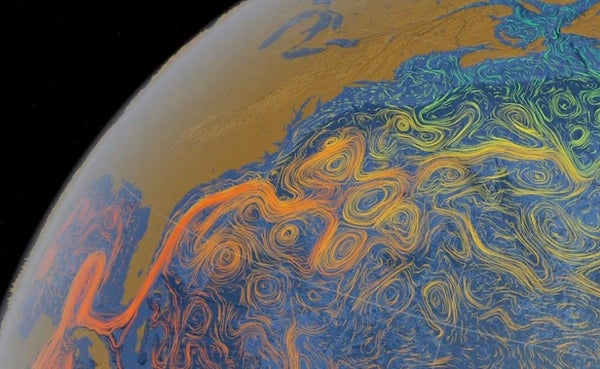
By combining massive amounts of diverse data, scientists from NASA and the Massachusetts Institute of Technology have created a beautiful high-resolution model of the Earth's ocean currents.
The project, called Estimating the Circulation and Climate of the Ocean (ECCO), uses observational data—including ocean surface topography, surface wind stress, temperature, salinity profiles and velocity data—collected between June 2005 and December 2007. By incorporating these data into an M.I.T. model, the result is "realistic descriptions of how ocean circulation evolves over time," according to the press release. "These model-data syntheses are among the largest computations of their kind ever undertaken.”
The video simulations capture the movement of tens of thousands of swirling currents. The image (above) reveals the circulation of the Gulf Stream on the U.S. east coast. Warm water from the Gulf of Mexico (shown in orange) flows northward up the coast and cools (shown in yellow and green) as it heads across the Atlantic toward Europe.
On supporting science journalism
If you're enjoying this article, consider supporting our award-winning journalism by subscribing. By purchasing a subscription you are helping to ensure the future of impactful stories about the discoveries and ideas shaping our world today.
NASA cautions that the model shows only the largest eddies, and they tend to appear more sharply defined here than in the real world. In addition, only these larger eddies have been adjusted to fit the observations, whereas the smaller ones were free to evolve according to the computer’s calculations.
Because ocean currents play a major role in transporting the planet's heat and carbon, the ECCO simulations are being used to understand the ocean's influence on global climate and the melting of ice in polar regions.
—Sarah Fecht