
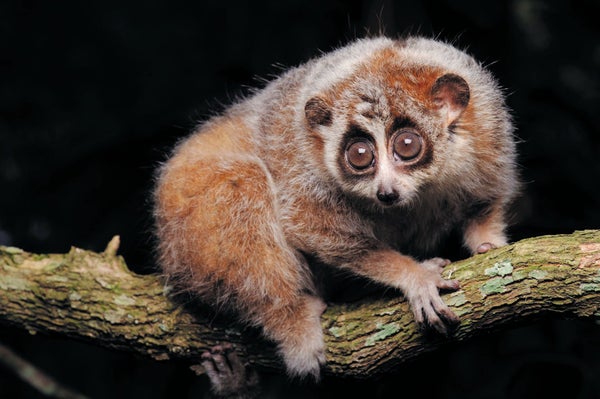
Wide-eyed, arboreal lorises—small mammals that secrete flesh-rotting venom to use in vicious territorial fights—are among the planet's strangest primates. And because they live in trees and are nocturnal, they are exceptionally difficult to study. “I've gone out for 10 nights in a row and not seen any,” says American Museum of Natural History conservation biologist Mary Blair.
In fact, there's so little information available, Blair says, that “every time somebody looks at lorises, they find something new”—even a new species. Discovery of primate species is especially rare because the group tends to be well studied, she notes. For a new study in Genes, she and her colleagues report their finding that the pygmy loris species is actually two: a lankier species with a longer muzzle primarily found in southern Vietnam, southern Laos and Cambodia (which retains the name Xanthonycticebus pygmaeus) and a fuzzier, button-nosed species in northern Vietnam, northern Laos and southern China, now called X. intermedius.
X. intermedius was first proposed as a separate species in 1960 by zoologist Dao Van Tien, but his idea was discounted because of a specimen mix-up. Others continued to suspect two distinct species, however. In 2016, for example, a pet trader in Japan told Oxford Brookes University conservationist Anna Nekaris, who co-authored the new study, that pygmy lorises came in two types—“ugly” and “cute”—and that his customers preferred the “cute” ones.
On supporting science journalism
If you're enjoying this article, consider supporting our award-winning journalism by subscribing. By purchasing a subscription you are helping to ensure the future of impactful stories about the discoveries and ideas shaping our world today.
The researchers' genetic analysis finally validated these observations. Rather than scouring the jungles for wild lorises, the team extracted DNA from 41 museum specimens in Vietnam and the U.S. Sequencing these samples showed that northern and southern pygmy lorises are distinct species whose most recent common relative lived 1.2 million years ago.
Today's lorises, cute as some are, number among few known venomous mammals; to fight, they lick special inner-elbow glands for poisonous oil that fills grooves in their teeth. Pygmy lorises were already listed as endangered, and the species split reveals a greater threat to each individual population. “The distribution of these species is much smaller than before,” says Truong Nguyen, a zoologist at the Vietnam Academy of Science and Technology, who was not involved in the study. “Therefore, we have to do more to conserve them.”