
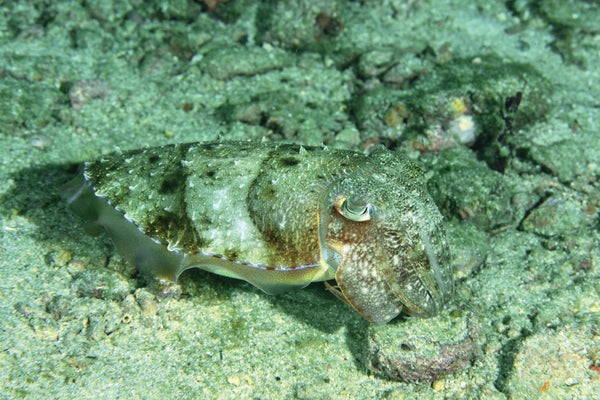
Cuttlefish are known for their sophisticated camouflage, as well as their kaleidoscopic displays for attracting mates and mesmerizing prey. These close relatives of squid and octopuses achieve such feats via millions of chromatophores—tiny sacs of pigment under the skin attached to muscles that squeeze or relax to push colors to the surface. In a new study, researchers report they have observed resting cuttlefish cyclically changing color and twitching their limbs in phases that resemble rapid eye movement (REM) sleep.
Many animals experience REM, a sleep phase that may involve eye movements and loss of muscle tone; in humans and some other mammals, it is often linked to dreaming. Study co-author Teresa Iglesias, a biologist at the Okinawa Institute of Science and Technology, cannot yet say whether cuttlefish experience the same kind of sleep that we do, but the animals' active phase during rest is similar to the REM sleep observed in humans and other vertebrates. Although the lineage that includes cuttlefish diverged from vertebrates around 500 million years ago, the study findings hint at a common evolutionary origin for sleep, she says.
Iglesias and her colleagues filmed cuttlefish in laboratory tanks for 24 to 48 hours at a time. While resting, the animals would demonstrate REM-like behavior for periods lasting between two and three minutes. They made sporadic arm and eye movements, and the chromatophores around their eyes got darker. Such phenomena were not observed during waking activity or inactive parts of their “sleep” cycles. The findings were published in January in the Journal of Experimental Biology.
On supporting science journalism
If you're enjoying this article, consider supporting our award-winning journalism by subscribing. By purchasing a subscription you are helping to ensure the future of impactful stories about the discoveries and ideas shaping our world today.
“Sleep is a neural phenomenon more than a behavioral one,” says psychologist Jennifer Mather, a cephalopod expert at the University of Lethbridge in Alberta, who was not involved in the new research. Cycles of brain activity while an animal is quiescent, she explains, suggest sleep may play a role in stabilizing neural circuitry and processing newly acquired information. The REM-like behavior observed in cuttlefish could indicate a similar process is happening in their brain, she says.
But do cuttlefish dream? “We can speculate all we like,” Mather says. “It's difficult because I don't [even] think we know why we dream.” Iglesias says it is not impossible, but there is not enough evidence to answer this question. “For now,” she says, “the biggest takeaway is that we need to dig deeper and keep an open mind.”