On supporting science journalism
If you're enjoying this article, consider supporting our award-winning journalism by subscribing. By purchasing a subscription you are helping to ensure the future of impactful stories about the discoveries and ideas shaping our world today.
In 1998 two teams of researchers made a milestone cosmological announcement: The universe, long known to be expanding, was not slowing down in its expansion as expected but was in fact accelerating. Both groups had been studying exploding stars, or supernovae, and used the objects' movement to show that the universe is speeding up. The culprit was labeled dark energy—a hypothesized presence that pervades space and pushes the pieces of the universe apart.
A new study that examines the growth of galaxy clusters rather than the movement of stars independently confirms the presence of dark energy. Researchers, led by Alexey Vikhlinin of the Harvard-Smithsonian Center for Astrophysics (CfA), found that dark energy seems to restrain the growth of clusters over time, hindering the gravitational clumping of matter that would allow them to grow even more massive.
Vikhlinin called the findings, which are set to be published in The Astrophysical Journal, "an unambiguous signature of dark energy." Such an effect is not entirely surprising: Astrophysicist Christopher Conselice of the University of Nottingham in England raised this as a likely role for dark energy in a 2007 Scientific American article.
The researchers said in a teleconference this week that the new look at dark energy is akin to sports referees making calls based on multiple vantage points. Whereas the existence of dark energy has been well supported for a decade, this new study helps to confirm its presence and to place constraints on just how strong its effects can be. Mario Livio, an astrophysicist at the Space Telescope Science Institute in Baltimore, says that it does not overturn dogma, but "it is nevertheless an observation that had to be made." Because so many of the early results came from the supernova approach, Livio says, it is important to verify the phenomenon with "a completely independent method."
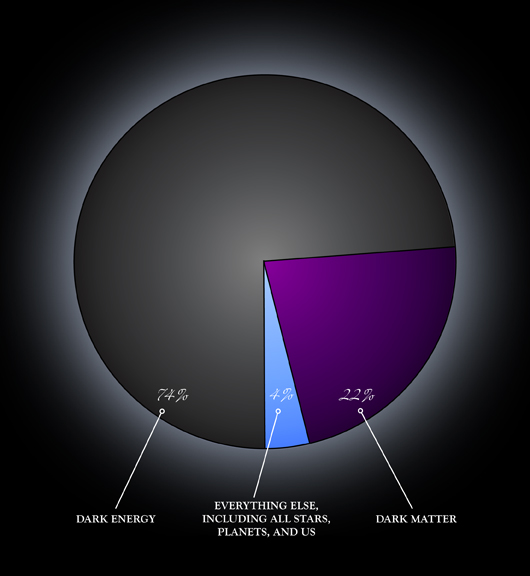
By studying far-flung galaxy clusters, astronomers are able to look back in time at the state of those objects millions or even billions of years ago, when the light just now reaching us was emitted. By comparing relatively close clusters with those more distant, the physical evolution of these gargantuan structures can be traced over time. Their observed development is "exactly what's expected for a universe with a low density of matter and a high density of dark energy," Vikhlinin said. (By current estimates, dark energy makes up nearly three quarters of the universe, dark matter comprises another 20 to 25 percent, and ordinary matter—all that we can see and touch—constitutes a mere 4 percent.)
What Vikhlinin and his co-authors observed is also what was expected for a universe described by Albert Einstein's theory of general relativity, the reigning theory of gravity. At the news conference, Princeton University astrophysicist David Spergel, who did not contribute to the research, called this further confirmation of dark energy "a triumph of general relativity."
Study co-author William Forman, a CfA astrophysicist, noted that although general relativity fit well with his team's observations, Einstein's vision may still require future adjustments. Livio agrees, but believes that the galaxy-cluster result nonetheless provides an important test for relativity. "There was the potential here, with this method," he says, "to tell us whether we had to modify our theory of gravity."