
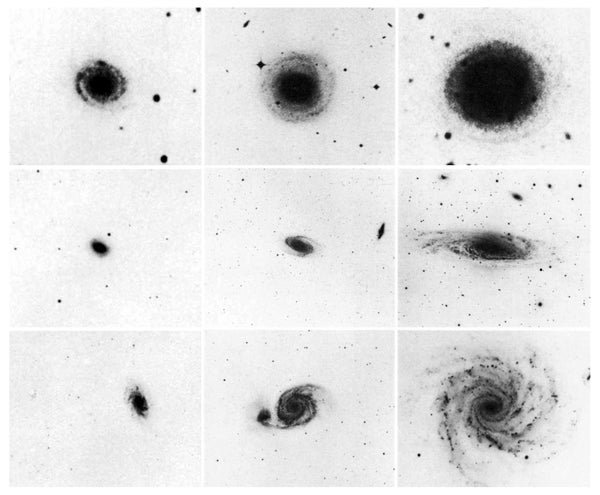
After evidence was obtained (in the 1920’s) that the universe is expanding it became reasonable to ask: Will the universe continue to expand indefinitely or is there enough mass in it for the mutual attraction of its constituents to retard the expansion and finally bring it to a halt? Most cosmologists agree that the universe started in a big bang 10 to 20 billion years ago from an infinitely small and dense state and that it has been expanding ever since. It can be calculated that the critical density of matter needed to brake the expansion and “close” the universe is on the order of 5 × 10–30 gram per cubic centimeter, which is equal to about three hydrogen atoms per cubic meter. The amount of luminous matter in the form of galaxies, however, comes to only about 7.5 × 10⁻³² gram per cubic centimeter. Therefore if the expansion of the universe is to stop, the density of the invisible matter must exceed the density of the luminous matter by a factor of roughly 70.
With this factor in mind astronomers over the past half century have sought to determine the mass of the galaxies that populate the universe out to the limits of observation. From the luminosity of typical galaxies one can estimate that they have a mass ranging from a few billion to a few trillion times the mass of the sun. The actual stellar population of a galaxy is of course highly diverse. Some stars are 10,000 times more luminous than the sun per unit of mass; others are only a small fraction as luminous. Given this diversity one would like to know: Is the distribution of luminosity in galaxies a reliable indicator of the distribution of mass? And, by extrapolation, is the distribution of luminosity in galaxies a reliable indicator of the distribution of mass in the universe?
My colleagues and I in the Department of Terrestrial Magnetism of the Carnegie Institution of Washington have sought to answer these questions by measuring the rotational velocity of selected galaxies at various distances from their center of rotation. It has been known for a long time that outside the bright nucleus of a typical spiral galaxy the luminosity of the galaxy falls off rapidly with distance from the center. If luminosity were a true indicator of mass, most of the mass would be concentrated toward the center. Outside the nucleus the rotational velocity would fall off inversely as the square root of the distance, in conformity with Kepler’s law for the orbital velocity of bodies in the solar system. Instead it has been found that the rotational velocity of spiral galaxies in a diverse sample either remains constant with increasing distance from the center or rises slightly out as far as it is possible to make measurements. This unexpected result indicates that the falloff in luminous mass with distance from the center is balanced by an increase in nonluminous mass.
On supporting science journalism
If you're enjoying this article, consider supporting our award-winning journalism by subscribing. By purchasing a subscription you are helping to ensure the future of impactful stories about the discoveries and ideas shaping our world today.
Our results, taken together with those of many other workers who have attacked the mass question in other ways, now makes it possible to say with some confidence that the distribution of light is not a valid indicator of the distribution of mass either in galaxies or in the universe at large. As much as 90 percent of the mass of the universe is evidently not radiating at any wavelength with enough intensity to be detected on the earth. Originally astronomers described the nonluminous component as “missing matter.” Today they recognize that it is not missing; it is just not visible. Such dark matter could be in the form of extremely dim stars of low mass, of large planets like Jupiter or of black holes, either small or massive. Other candidates include neutrinos (if indeed they have mass, as recent work suggests) or such hypothetical particles as magnetic monopoles or gravitinos.

Kepler’s law for the orbital velocity of planets in the solar system, in which more than 99 percent of the total mass resides in the sun, yields this plotted curve. Orbital velocity decreases inversely as the square root of r, the planet’s mean distance from the sun. The distance is shown here in astronomical units; one A.U. equals the mean distance between the earth and the sun. Pluto, at 39.5 A.U., lies 100 times farther from the sun than Mercury, at .39 A.U. Mercury’s orbital velocity is about 47.9 kilometers per second; Pluto’s velocity is accordingly slower by a factor of 10, or 4.7 kilometers per second (47.9 × 1/√100). The author’s results show that the orbital velocities of stars in a spiral galaxy depart strongly from a Keplerian distribution.
Gabor Kiss
Early in this century it was reasonable for astronomers to assume that the distribution of luminous matter, wherever it was found, coincided with the distribution of mass. Nearly 50 years ago, however, Sinclair Smith and Fritz Zwicky of the California Institute of Technology discovered that in some large clusters of galaxies the individual members are moving so rapidly that their mutual gravitational attraction is insufficient to keep the clusters from flying apart. Either such clusters should be dissolving or there must be enough dark matter present to hold them together. Almost all the evidence suggests that clusters of galaxies are stable configurations. Hence the early observations of Smith and Zwicky marshaled the first evidence that such clusters harbor matter both luminous and nonluminous.
Recent work by many other astronomers has strengthened this conclusion. Studies of the dynamics of individual galaxies, including our own galaxy, of pairs of galaxies, of groups of galaxies and of clusters of galaxies all point to a component of unobservable but ubiquitous mass. Such studies detect the presence of nonluminous mass solely by its gravitational effects.
For the past several years W. Kent Ford, Jr., Norbert Thonnard, David Burstein and I have sought to learn about the distribution of mass in the universe by investigating the distribution of matter within galaxies with a structure similar to that of our own galaxy, namely the general class of spiral galaxies. We have adopted this approach because spiral galaxies have a geometry favorable for the identification of mass, whether it is luminous or nonluminous, and modern large telescopes equipped with image-tube spectrographs make it possible to complete an observation of a single galaxy with an exposure of about three hours. Before I describe our observations it will be helpful if I review how celestial objects respond to the gravitational force acting on them and how that response can reveal the large-scale distribution of matter.
Toward the end of the 17th century Robert Hooke suspected that the planets were subject to a gravitational force from the sun whose intensity decreased inversely as the square of the distance. Isaac Newton then recognized that all pairs of objects in the universe have a gravitational attraction for each other that is proportional to the product of their masses and inversely proportional to the square of the distance between them. In other words, if the distance between the objects is increased by, say, a factor of two, their mutual attraction decreases by a factor of four.
For planets in orbit around the sun, which embodies essentially all the mass in the solar system, the decrease in gravitational attraction with distance is exactly paralleled by a decrease in the velocity needed to hold the planet in its orbit. Therefore Mercury, lying at .39 astronomical unit from the sun (that is, .39 of the mean distance between the sun and the earth), has an orbital velocity of about 47.9 kilometers per second. Pluto, 100 times farther away at a mean distance of 39.5 astronomical units, has an orbital velocity only a tenth that of Mercury, or 4.7 kilometers per second. Spiral galaxies rotate because they retain the angular momentum and the orbital momentum of the initial clumps of gas from which they formed.
In a spiral galaxy the gas, dust and stars in the disk of the galaxy (together with any associated planets and their satellites) are all in orbit around a common center. Like the planets in the solar system, the gas and stars move in response to the combined gravitational attraction of all the other mass. If the galaxy is visualized as a spheroid, the gravitational attraction due to the mass Mr lying between the center and an object of mass m in an equatorial orbit at a distance r from the center is given by Newton’s law GmMr/r2, where G is the constant of gravitation. If the galaxy is neither contracting nor expanding, the gravitational force is exactly equal to the centrifugal force on the mass at distance r: GmMr/r2 = mVr2/r, where Vr is the orbital velocity.
When this equation is solved for Vr, the value of m drops out and the velocity of a body at distance r from the center is determined only by the mass Mr inward from its position. If, as in the solar system, virtually all the mass is near the center, then the velocities outward from the center decrease as 1/r2. Such a decrease in orbital velocity is called Keplerian after Johannes Kepler, who first stated the laws of planetary motion.
In a galaxy the brightness is strongly peaked near the center and falls off rapidly with distance. Astronomers had long assumed that the mass too decreased rapidly with distance, in accordance with the distribution of luminosity. Hence it was expected that stars at increasing distances from the center would have decreasing Keplerian orbital velocities. Until recently few velocity observations had been made in the faint outer regions of galaxies, either to confirm this expectation or refute it.
Although the forms of spiral galaxies are exceedingly diverse, astronomers are able to group them into three useful classes following a scheme proposed some 60 years ago by Edwin P. Hubble. Galaxies designated Sa have a large central bulge surrounded by tightly wound smooth arms in which “knots,” or bright regions, are barely resolved. Sb galaxies have a less pronounced central bulge and more open arms with more pronounced knots. Sc galaxies have a small central bulge and well-separated arms speckled with distinct luminous segments. The progression from type Sa to type Sc is one of decreasing prominence of the central bulge and increasing prominence of the disk rotating about it. That the disk is indeed rotating is assumed on simple dynamical grounds.
Within each type there are systematic variations in size and luminosity. For example, Sc galaxies range from small, low-luminosity, low-mass objects to galaxies of enormous luminosity and mass. For completeness, therefore, the study of the dynamics of galaxies should include not only objects with a range of morphological types but also objects with a range of luminosities.
Only for the closest stars in our own galaxy is it possible to detect motion by observing the changing position of the star against the background of more distant stars and galaxies on the celestial sphere. Even for the Andromeda galaxy, the large spiral galaxy closest to our own, it would take some 20,000 years for an orbital velocity of 200 kilometers per second (a velocity comparable to the sun’s) to carry a star one second of arc across the sky. This is the minimum angular separation that can be detected optically from the earth. To study the motions in galaxies a different method is needed, one based on the phenomenon of the Doppler shift.
Doppler shifts are shifts in the frequency of waves from a source caused by the motion of the source toward or away from the observer. When the spectrum of the bright nucleus of a spiral galaxy is recorded, the absorption lines arising from the constituent stars are shifted toward the long-wavelength (red) end of the spectrum compared with the same lines in spectra made in laboratories on the earth. Such red shifts in the spectra of all but a few of the nearest galaxies, first observed in about 1915 by V. M. Slipher of the Lowell Observatory, provide the evidence that the universe is expanding, carrying almost all the other isolated galaxies away from ours and away from one another. As a result of Smith and Zwicky’s work it is known that in pairs, groups and clusters of galaxies the local gravitational field overcomes the general expansion, so that these denser agglomerations of matter remain bound. Although the distances between clusters of galaxies are increasing, the distances between galaxies within clusters remain about the same. Slipher also noted that the spectra of individual galaxies can yield additional information about the motions of stars and gas within the galaxy.

Spectrum of spiral galaxy NGC 7541 (right) was recorded with the four-meter telescope at the Kitt Peak National Observatory by the author and W. Kent Ford, Jr. NGC 7541 is a type Sc spiral, 60 megaparsecs distant. (A megaparsec is 3.26 million light-years.) The exposure time was 114 minutes. The galaxy is seen at the left as it appears on a television monitor in the telescope’s console room. The dark line through the galaxy shows the orientation of the spectrograph slit. Light from across the disk is sampled (see illustration below).
Vera C. Rubin, Carnegie Institution of Washington

Emission lines in the spectrogram of NGC 7541 arise from two sources: the night sky and atoms in the gas clouds surrounding bright stars in the galaxy. Most of the night-sky lines, which extend across the entire width of the spectrogram, are from hydroxyl (OH) molecules in the atmosphere of the earth. A few arise from oxygen and hydrogen atoms in the earth’s atmosphere. The rotation of NGC 7541 shifts the position of the emission lines from the disk of the galaxy to either a shorter (bluer) wavelength or a longer (redder) one, depending on whether the rotation is carrying the stars and gas in the disk toward or away from the observer. Because the galaxy itself is traveling away from the observer as part of the general expansion of the universe, the hydrogen-alpha line from gas in the galaxy is red-shifted from the position of the same line in the night sky. The displacement is a measure of the galaxy’s velocity of recession. The slant of the galactic emission lines shows that the orbital velocity of stars and gas in the disk is increasing with distance from the galactic center.
Gabor Kiss
If the disk of a spiral galaxy is oriented so that its plane is sharply tilted with respect to the line of sight from the earth, the rotation of the galaxy will carry the stars and gas on one side of the galactic nucleus toward our galaxy and those on the other side away from it. The spectral lines of the approaching material will therefore be blue-shifted, or raised in frequency, and the lines of the receding material will be red-shifted, or lowered in frequency. A measurement at any point on a spectral line will therefore supply both the angular distance of that point from the galactic nucleus and the velocity along the line of sight at that distance.
It is difficult to make spectroscopic measurements of the velocities of individual stars, which are faint even in galaxies fairly close to our own. In our work, therefore, we observe not stars but the light from the clouds of gas, rich in hydrogen and helium, that surround certain hot stars. The spectra of such clouds consist of bright emission lines that arise as an electron in an excited atom drops from a higher energy state to a lower one. In addition to emission lines of hydrogen and helium there usually are bright lines from atoms of nitrogen and sulfur that are singly ionized, or stripped of one electron. These lines are called forbidden because they arise only from atoms in the near-vacuum of space; in terrestrial laboratories such singly ionized atoms are rapidly deexcited by collisions with other atoms before the forbidden transition can occur.
Until recently it was not possible to get high-resolution optical spectra of the faint outer regions of galaxies. It is the present availability of large optical telescopes, of high-resolution, long-slit spectrographs and of efficient electronic imaging devices that have made our observing program feasible. Six years ago my colleagues and I set out to measure the rotational velocities completely across the luminous disk of suitably tilted spiral galaxies. Our aim was to study the internal dynamics and distribution of mass in individual galaxies as a function of the galaxies’ morphology. We have now observed 60 spiral galaxies: 20 each of the three major types Sa, Sb and Sc. We have selected galaxies that have a well-defined type, that are well inclined to the plane of the sky (yielding a large component of orbital velocity along the line of sight), that have an angular diameter no larger than the slit of the spectrograph and that span a large range of luminosities within each type.
Most of the spectra have been obtained with two four-meter telescopes, the one at the Kitt Peak National Observatory in Arizona and the one at the Cerro Tololo Inter-American Observatory in Chile. A few of the spectra were recorded with the 2.5-meter telescope at the Las Campanas Observatory in Chile.

Measurement of the rotation of NGC 2998, an Sc galaxy at a distance of 96 megaparsecs in the constellation Ursa Major, begins with the making of a spectrogram. The picture at the top shows the galaxy and superposed spectrograph slit as they appear on a television monitor at the four-meter Kitt Peak telescope. Below it is the hydrogen-alpha region of the spectrogram that resulted from an exposure of 200 minutes. The plotted points depict velocities across the galactic disk as measured from the hydrogen-alpha line. The entire galaxy is receding at 4,800 kilometers per second; the left side of the galaxy is approaching, the right side receding. The last step is to draw a rotation curve by smoothing velocities from both sides of the disk and translating angular distance on the sky into linear distance in the galaxy.
Vera C. Rubin, Carnegie Institution of Washington (photograph and spectrogram); Gabor Kiss (graphs)
After the photons from the galactic source pass through the slit of the spectrograph and are dispersed by a diffraction grating, they are focused on a “Carnegie” image tube (RCA C33063), where they are multiplied by a factor of 10 or more before they are recorded by the photographic emulsion. Exposures of two to three hours are recorded on Kodak IIIa-J plates whose sensitivity, matched to that of the image tube, has been much increased by having previously been baked at 65 degrees Celsius for two hours in a special “forming” gas (nitrogen with an admixture of 2 percent hydrogen) and preexposed to flashes of light. Without the image tube and the plate-sensitizing methods exposure times would have been prohibitively long: from 20 to 60 hours.
Generally two exposures are made of each galaxy. In one exposure the spectrograph slit is made to coincide with the major (long) axis of the galaxy; each point on the spectrum arises from a single region of the galactic disk. The Doppler, or velocity, displacements of the emission lines are readily discerned in the developed image. A second exposure is made with the spectrograph slit aligned with the minor axis of the galactic disk. Since the orbital velocities are now perpendicular to the line of sight, no Doppler shifts are evident. The absence of line displacements with the slit along the minor axis is confirming evidence that the motions we study are indeed orbital ones.In order to have a reference scale against which to measure the displacement of emission lines in galactic spectra astronomers formerly recorded neon lines from a lamp along the edges of the spectrum. We have now dispensed with this procedure. Instead we measure displacements directly from the unshifted lines on each plate that are emitted by hydroxyl (OH) molecules in the earth’s atmosphere. Many astronomers have adopted sophisticated plate-scanning devices to measure line positions, particularly for faint signals. We, however, still measure the location of the emission lines with the aid of a microscope whose stage can be moved in two directions. We are able to measure positions in each coordinate to the high accuracy of one micrometer.
In our work we define the nominal radius of a galaxy as that distance at which the surface brightness of the galaxy has fallen to the threshold of detectability on plates made with the 48-inch Schmidt telescope on Palomar Mountain, a value equal to 25th magnitude per square second of arc. For establishing the distance to the objects examined, and hence their actual size, we adopt a value for the Hubble constant (which specifies the expansion rate of the universe) of 50 kilometers per second per megaparsec. (A megaparsec is 3.26 million light-years.)

Rotation curves show orbital velocities of nine Sc galaxies from the center outward. Galaxies increase in luminosity from top to bottom. With increasing luminosity galaxies are larger, orbital velocities are higher and velocity gradients near the galactic center are steeper.
Gabor Kiss
From the measured velocities of the strongest emission lines we compute a smooth rotation curve by averaging together the approaching and receding velocities from the two sides of the galactic disk. Although each galaxy exhibits distinctive features in its rotational pattern, the systematic trends that emerge are impressive. With increasing luminosity galaxies are bigger, orbital velocities are higher and the velocity gradient across the nuclear bulge is steeper. Moreover, each type of galaxy displays characteristic rotational properties. For example, the most luminous Sa galaxies rotate more than 50 percent faster at the midpoint of their radius than equally luminous Sc galaxies. Among Sc galaxies the most luminous rotate more than twice as fast at comparable radial distances as Sc galaxies that are only a hundredth as luminous.One overwhelming conclusion emerges from our observations. Virtually all the rotation curves are either flat or rising out to the visible limits of the galaxy. There are no extensive regions where the velocities fall off with distance from the center, as would be predicted if mass were centrally concentrated. The conclusion is inescapable: mass, unlike luminosity, is not concentrated near the center of spiral galaxies. Thus the light distribution in a galaxy is not at all a guide to mass distribution.
On the basis of their rotational velocities the masses of the galaxies in our study range from 6 × 10⁹ to 2 × 10¹² times the mass of the sun inside their optical radius. We cannot yet specify the total mass of any one galaxy because we do not see any “edge” to the mass. Instead the mass inside any given radial distance is increasing linearly with distance and, contrary to what one might expect, is not converging to a limiting mass at the edge of the visible disk. The linear increase of mass with radius indicates that each successive shell of matter in the galaxy must contain just as much mass as every other shell of the same thickness. Since the volume of each successive shell increases as the square of the radius, the density of matter in successive shells must decrease as 1 over the radius squared in order for the product of the density times the volume to remain constant.
The theoretical model that least disturbs generally accepted ideas about galaxies accounts for the observed rotation curves by embedding each spiral galaxy in a spherical “halo” of matter that extends well beyond the visible limits of the galactic disk. The gravitational attraction of this unseen mass keeps the orbital velocities of the galaxies from decreasing with distance from the galactic center. It is perhaps disappointing that the observations yield almost no information on the detailed distribution of the invisible dark matter. One can nonetheless say that the dark matter is not part of the overall background density of matter in the universe but rather is strongly clumped around galaxies. This is evident because the density of nonluminous matter decreases, albeit slowly, with distance from the galactic center, and the density even at large radial distances is between 100 and 1,000 times higher than the mean density of the universe.

Orbital velocities are depicted schematically for Sc galaxies of varying luminosity as a function of the optically visible radius of each galaxy. Luminosities in solar units differ by two orders of magnitude. At every radial distance orbital velocities increase with luminosity.
Gabor Kiss

Comparison of Sa and Sc galaxies shows that for equal luminosity orbital velocities are significantly higher in Sa galaxies than they are in Sc galaxies at every radial distance. This implies that Sa galaxies harbor more mass per unit of luminosity than Sc galaxies do.
Gabor Kiss
Although there are other models that try to account for the high orbital velocities, all are less satisfactory than a single halo of dark matter. If all the required unseen matter is put in a disk, the disk will quickly become unstable and form itself into a bar. The important finding that halos are necessary for stabilizing a disk was first elucidated by Jeremiah P. Ostriker and P. J. E. Peebles of Princeton University.
The observed dynamic effects are reproduced by models of spiral galaxies that put the mass in a nucleus, a surrounding bulge, a disk and a halo. Particularly interesting models have been developed by John N. Bahcall and Raymond M. Soneira of the Institute for Advanced Study, Maarten Schmidt of Cal Tech and S. Casertano of the Scuola Normale Superiore in Pisa. Perhaps the most radical idea for explaining the observed high rotational velocities is one advanced independently by Joel E. Tohline of Louisiana State University and M. Milgrom and J. Bekenstein of the Weizmann Institute of Science. They have proposed that at great distances the Newtonian theory of gravitation must be modified, thereby allowing rotational velocities in galaxies to remain high at such distances from the galactic center even in the absence of unseen mass.
Additional evidence on the high rotational velocities of matter in spiral galaxies is provided by the 21-centimeter radio waves emitted by the neutral (unionized) hydrogen in the galactic disk. Early studies of the 21-centimeter radiation of a few spiral galaxies by Morton S. Roberts of the National Radio Astronomy Observatory showed that the rotational velocities of the hydrogen are high. With multiple radio telescopes, notably the array at Westerbork in the Netherlands and the Very Large Array at Socorro, N .M., it is possible to match and even exceed the resolving power of optical telescopes and thereby to study the distribution of hydrogen in galaxies similar to those we have observed. Albert Bosma of the State University of Leiden has shown for a wide variety of galaxy types that the orbital velocities of neutral hydrogen remain high at large distances from the galactic center.
In general the apparent diameters of galaxies are similar whether they are measured by optical observations or by radio ones. For a small set of galaxies, however, hydrogen extends several times as far out from the center as the luminous stars do. For such objects it is possible to determine the gravitational potential beyond the limits of the optically visible galaxy. In several instances the hydrogen does not remain in a plane but is warped sharply near the edge of the visible disk. It is therefore not certain whether the gas velocities that have been measured at the largest distances from the center are true circular orbital velocities or whether they represent more complex motions.
Renzo Sancisi of the University of Groningen, who has studied such warped galaxies, has suggested that the orbital velocities may in fact be decreasing beyond the limits of the visible galaxy. The velocities, however, seem to decrease only slightly, perhaps by 20 kilometers per second, or about 10 percent, and then hold constant at that value at larger distances. The radio observations are continuing and should offer important information on the far outer regions of galaxies.

Mass inside a given radial distance can be calculated from the equivalence of gravitational force and centrifugal force at distance r from the center of the galaxy. In the equations G is the constant of gravitation, m is the mass at distance r, Mr is the mass inside r and Vr is the orbital velocity of mass m. The mass inside r increases linearly with distance. The table gives the mass inside r for two Sc galaxies: NGC 1035, of low luminosity, and NGC 2998, of high luminosity. At every distance from the galactic center the more luminous galaxy exhibits a higher orbital velocity and therefore must have much more mass inside that distance.
Gabor Kiss
Students of galaxies are fortunate in being able to examine the properties of galaxies a long way off and then return to the galaxy where they live and ask if it exhibits the same features as other galaxies. It was not so long ago that astronomers believed the sun, about eight kiloparsecs from the center of our galaxy, was near the edge of it and that the galaxy was only of moderate size. Now all the evidence indicates that our galaxy too extends well beyond the position of the sun and that its mass continues to increase.
The velocity of the sun in its orbit around the center of the galaxy is placed at 220 kilometers per second by James E. Gunn and Gillian R. Knapp of Princeton and Scott D. Tremaine of the Massachusetts Institute of Technology. Other estimates run as high as 260 kilometers per second. At the lower value the amount of mass between the sun and the center of the galaxy is about 1011 solar masses. On the evidence that substantial mass lies beyond the sun’s distance from the galactic center, the galactic mass out to 100 kiloparsecs may reach 1012 solar masses, which would place our galaxy in a class with the largest galaxies of its type.

Comparisons of interior mass for both low- and high-luminosity galaxies show that the mass rises with approximate linearity with distance r from the center and gives no sign of approaching a limit at the edge of the optically visible galaxy. At every radial distance Sa galaxies exhibit higher mass and therefore higher density than Sc galaxies of equal luminosity.
Gabor Kiss

Studies of our own galaxy yield estimates of the mass inside r measured in kiloparsecs from the galactic center. The estimates are calculated from the orbital velocities and mean distances of a variety of objects. The value adopted for the orbital velocity of the sun at a distance of eight kiloparsecs is 220 kilometers per second. The second point is obtained from the mean velocity of carbon monoxide clouds at a mean distance of 18 kiloparsecs, measured by Leo Blitz of the University of Maryland at College Park. The third and fifth points are derived from the velocity of globular clusters of stars in the “halo” of our galaxy at two different average distances from the nucleus. The velocities of the nearer clusters were analyzed by Carlos Frenk, who was then working at the University of Cambridge, and Simon White of the University of California at Berkeley. The velocities of the more distant clusters were studied by F. D. A. Hartwick of the University of Victoria and Wallace L. W. Sargent of. the California Institute of Technology. The fourth point was obtained from velocities of the Clouds of Magellan, the nearest galaxies to our own, as estimated by Tadayuki Murai and Mitsuaki Fujimoto of Nagoya University. The sixth point represents independent estimates of the distance and velocities of the Clouds of Magellan made by D. N. C. Lin of the Lick Observatory and Donald Lynden-Bell of the University of Cambridge. The final point is based on the velocity of more remote satellite galaxies as estimated by Jaan Einasto and his colleagues at the Estonian S.S.R. Academy of Sciences. The extent of the vertical lines indicates the range of values for orbits of different geometries. The measurements suggest that rotational velocities in our galaxy lie between 220 and 250 kilometers per second and remain constant out to 80 kiloparsecs, or roughly 10 times the sun’s distance from the galactic center. The mass inside 80 kiloparsecs is likewise some 10 times the mass inside the radial distance of the sun, or about 1012 solar masses.
Gabor Kiss
Some 30 years ago Jan H. Oort of the Leiden Observatory demonstrated that the observable mass of stars and gas in the galactic disk in the vicinity of the sun is too low by almost a factor of two to account for the disk’s gravitational attraction on the stars far out of its central plane. This study offered the first evidence that our galaxy too harbors mass that is not luminous.
More recent evidence comes from the orbital velocities of objects in the plane of the galaxy considerably farther out than the sun. Measurements are difficult, but the velocities have been deduced for a few special cases. For example, Leo Blitz of the University of Maryland at College Park has determined the velocities of clouds of carbon monoxide at a distance of nearly 16 kiloparsecs from the galactic center. These velocities, together with the velocities of hydrogen clouds determined by Blitz and Shrinivas Kulkarni and Carl E. Heiles of the University of California at Berkeley, yield a rotation curve that continues to rise with increasing distance from the galactic center.
In order to deduce the mass at still larger distances the velocities of globular star clusters in the halo of our galaxy, with one sample of clusters at 30 kiloparsecs from the center and another at 60 kiloparsecs, have been measured by F. D. A. Hartwick of the University of Victoria, Wallace L. W. Sargent of Cal Tech, Carlos Frenk of the University of Cambridge and Simon White of the University of California at Berkeley. Their work shows that the mass continues to increase with approximate linearity to the mean distance of the clusters.
With effort and imagination it is possible to sample the gravitational potential at even more remote distances. Our galaxy is not alone in intergalactic space; it has a retinue of smaller satellite galaxies. The orbits of the two closest satellites, the Large and Small Clouds of Magellan, a little less than 60 kiloparsecs from the center of our galaxy, are highly uncertain. Model orbits have been proposed, however, by Tadayuki Murai and Mitsuaki Fujimoto of Nagoya University, D. N. C. Lin of the Lick Observatory and Donald Lynden-Bell of the University of Cambridge. From the model orbits they deduce values of mass that are consistent with those yielded by the globular clusters.
For still greater distances Jaan Einasto and his colleagues at the Estonian S.S.R. Academy of Sciences have relied on a combination of enormously distant globular clusters and satellite galaxies to deduce the mass to distances beyond 80 kiloparsecs. When the results from such analyses are combined, they indicate a galaxy in which orbital velocities remain in the range of 220 to 250 kilometers per second out to almost 10 times the distance of the sun from the galactic center. Such a mass distribution is mandatory if our galaxy is to resemble all the other spiral galaxies my colleagues and I have studied. It moves the sun from a relatively rural position to a much more urban one.
The broad conclusion that can be drawn from all these results is that as the disk of a spiral galaxy is scanned from the center outward the total mass of luminous and dark material falls off slowly and the luminosity (measured in the blue region of the spectrum) falls off rapidly. As a result the ratio of the local mass density to the local (blue) luminosity density, which can be expressed for convenience as the value of the ratio M/L, increases steadily with distance from the galactic center. In the nuclear region a lot of luminosity is produced by relatively little mass, whereas at large distances little luminosity is produced by a lot of mass. If there were no invisible material clumped around galaxies, the mass distribution would simply follow the luminosity distribution and the M/L ratio would be approximately constant across the disk from its center to its edge.
If mass and luminosity are measured in units of solar mass and solar luminosity, the M/L ratio of the sun is of course 1/1. In such units (omitting the denominator, which is simply 1) the average M/L ratio near the nucleus of a spiral galaxy has sunlike values of 1 or perhaps 2 or 3. Toward the edge of the visible disk, as luminosity decreases, the M/L value climbs to 10 or 20. Beyond the visible disk, where the luminosity falls essentially to zero and the mass remains high, the average M/L value soars into the hundreds.

Hypothetical and actual galaxies deviate sharply in all their properties except luminosity. The typical actual spiral galaxy at the bottom has a massive nonluminous halo. The hypothetical galaxy at the top has no halo. Its surface brightness decreases rapidly, orbital velocities outside the nucleus decrease in Keplerian fashion, local mass density falls in parallel with luminosity, integral mass reaches a limiting value and the ratio of mass to luminosity stays approximately constant with increasing radial distance. Such were the expected properties of a galaxy. In an actual galaxy the presence of a dark halo changes everything but the galaxy’s optical appearance. The orbital velocities remain high, the local mass density falls only slowly, the integral mass increases linearly with radius and the mass-to-luminosity ratio steadily increases as the halo of the galaxy contributes more mass and the luminous disk falls to the threshold of detectability.
Gabor Kiss

Mass and luminosity are compared for typical components of a spiral galaxy such as our own. The mass and luminosity of the sun are taken as unity. In solar units the value of the ratio of mass to luminosity, M/L, for normal stars decreases from about 30 for cool, old dwarf stars (type M5) to about 10–4 for hot, young stars (type O5). Only extremely dense white-dwarf stars have an M/L value in excess of 100. Some other class of objects is needed to populate the halo of a galaxy, where M/L values soar into the hundreds.
Gabor Kiss
In an effort to identify the constituents of the invisible halo we must ask what celestial objects have high values of M/L. Stars like the sun are clearly ruled out. The luminous hot young stars that delineate a galaxy’s spiral arms are even poorer candidates; their M/L values are about 10–4. At the other extreme the old red-dwarf stars that populate the nuclear bulge and the outlying regions of the galaxy have both a low mass and a low blue luminosity. Their M/L values, about 20, are still far short of the values needed for the halo. Moreover, a halo consisting of very-low-mass red dwarfs would reveal its presence by radiating strongly in the infrared region of the spectrum. All attempts to detect a halo by its visual, infrared, radio or X-ray radiation have failed.
What candidates are left? Normal stars radiate energy generated by thermonuclear processes, which convert hydrogen and helium into heavier elements. Such nuclear processes are kindled only in bodies whose mass is large enough for the gravitational energy to raise the temperature at the core of the star to several million degrees Kelvin (degrees C. above absolute zero). The minimum mass required is about .085 times the mass of the sun. Jupiter, the largest planet in the solar system, falls short of this value by a factor of nearly 100. A halo of planetlike bodies, perhaps protostars that failed to become stars, is at least conceivable, although rather unlikely. In sum, the only requirement for the halo is the presence of matter in any cold, dark form that meets the M/L constraint, from neutrinos to black holes.
So far I have described the rotational properties of relatively isolated normal spiral galaxies. There is additional observational evidence for high M/L ratios at large distances from the nuclei of other galaxies. Occasionally nature offers an unexpected opportunity to probe its secrets. Recently François Schweizer of the Carnegie Institution, Bradley C. Whitmore of Arizona State University and I have been fascinated by the faint “anonymous” galaxy AO 136-0801, one of a class of spindle galaxies with polar rings. It is called anonymous because it is not listed in any of the standard galactic catalogues; its numerical designation corresponds to its location in the sky.
Our observations of the distribution of light across the spindle show that it is a low-luminosity disk of stars viewed nearly edge on, with little or no gas and dust and no spiral structure. Such galaxies are classed as SO galaxies and represent a significant fraction of all disk galaxies. By our usual methods we have determined the rotational properties of the disk by measuring the Doppler shift of absorption lines from its component stars. A short distance from the center of the object along the major axis of the spindle rotational velocities reach 145 kilometers per second, a value that corresponds closely to velocities measured in type-Sa galaxies of low luminosity. Along the minor axis the orbital velocities show no line-of-sight component, confirming evidence that we are observing a rotating disk of stars.
The unusual feature of AO 136-0801 is a large ring, also seen nearly edge on, that encircles the narrow axis of the spindle by passing almost over the disk’s center of rotation [see illustration below]. The ring is composed of gas, dust and luminous young stars. The gas reveals itself by its emission-line spectrum, the dust by its absorbing effects where it crosses in front of the spindle and the stellar component by its knotty, bluish appearance in photographs. The maximum diameter of the ring is several times greater than the long axis of the spindle. As a consequence the motions of the objects in the ring offer a unique opportunity to probe the gravitational field perpendicular to the galactic disk out to distances exceeding the visible radius of the disk.

Disk inside a ring is exhibited by the “anonymous” galaxy AO 136-0801, so called because it is not listed in standard catalogues. (The numbers give its position in right ascension and declination.) The oval central region is a rotating disk of stars seen nearly edge on. The stars and gas in the thin ring are also rotating but in a plane almost perpendicular to the disk. The directions of rotation are indicated by the diagram in the middle, which shows how the slits of the spectrograph were oriented for measuring orbital velocities in the disk and the ring. The two sets of velocity measurements are plotted at the right. At 10 seconds of arc from the center the velocities in the disk (black) and in the ring (color) are essentially the same. The velocities in the ring, however, can be measured out to nearly three times the optical radius of the disk, and they remain virtually constant. It appears that the mass is continuing to increase linearly out to distances much greater than the disk radius, and that objects in the ring respond to a gravitational potential that is not disklike but spherical.
Vera C. Rubin, Carnegie Institution of Washington (left); Gabor Kiss (right)
Our spectrographic observations confirm that the ring is indeed rotating at right angles to the plane of rotation of the disk. It seems improbable that this dynamical configuration could have arisen in the normal evolution of an isolated disk galaxy; the configuration must be the result of some kind of event, such as an encounter with another galaxy or with a disk of gas. By measuring the displacement of emission lines we find that the ring’s velocity of rotation is about 170 kilometers per second and that the velocity curve is flat or slightly rising out to a distance of almost three times the radius of the inner disk. If the velocity curves of the disk and the ring are plotted on the same velocity-distance scale, the two are seen to have nearly identical values at the same distance from the center of the galaxy. The high rotational velocity of the ring offers strong evidence for the existence of a massive halo extending at least three times farther than the visible radius of the disk. Moreover, the shape of the halo must be more nearly spherical than disklike. Calculations show that if the halo were as flat as the disk, the velocities above the plane of the disk would be smaller than those in the disk by 20 to 40 percent.
I have been describing determinations of mass made by measuring the velocity of orbiting test objects, objects in the central disk of a galaxy and objects orbiting the pole of an unusual galaxy. Other special instances can help to shed light on the quantity of dark matter in the universe. Galaxies often exist in pairs. In such instances one galaxy can be considered a test object in orbit around the other. The analysis of such a system is complex because both the orientation of the orbit in space and the position of the galaxy in the orbit are unknown. One can, however, resort to the observed properties in a large sample of double galaxies (the difference between the velocities of the two galaxies, their angular separation and their luminosity) to infer from statistical arguments the probable distribution of orbital elements and M/L ratios appropriate to the galaxies.
Independent analyses by Edwin L. Turner of Princeton, Steven D. Peterson, working at Cornell University, Linda Y. Schweizer of the Carnegie Institution and I. D. Karachentsev of the Special Astrophysical Observatory in the U.S.S.R. yield mean M/L values in the range between 25 and 100. These values of M/L are an average over a distance equal to the separation of the galaxies in each pair, a distance generally equal to several galaxy diameters, or on the order of 100 kiloparsecs. This result helps to confirm the view that halos of dark matter, with large values of M/L, extend well beyond the optical limits of galaxies.
We can now return to our original question: Does the universe contain enough invisible matter to raise the average density to 5 × 10–30 gram per cubic centimeter, the value needed to close the universe and bring its expansion to a halt? As we have seen, such a density would be reached if the density of nonluminous matter exceeded the density of luminous matter by a factor of about 70. Alternatively what would be needed to close the universe can be expressed in terms of the ratio of total mass to luminosity. That value is roughly 700, compared with 1 for the sun.
Is there any evidence that the M/L value of 700 is approached? Averaged over the visible disks of spiral galaxies, the ratio of total mass (luminous and nonluminous) to luminosity is about 5. For SO and elliptical galaxies the M/L value is higher, on the order of 10. For double galaxies and small groups of galaxies the M/L value increases to between 50 and 100. Analyses of galaxy motions in large clusters indicate M/L values of several hundreds. This increase in mean M/L value with increasing distance from the center of the system was first stressed a decade ago by Einasto, Ants Kaasik and Enn Saar of the Estonian S.S.R. Academy of Sciences, and also by Ostriker and Peebles and by Amos Yahil of the State University of New York at Stony Brook. So far there is no evidence for the existence of M/L values above the critical one of 700 needed to close the universe. The highest of the derived values, however, comes tantalizingly close. Some physicists consider it significant that the inferred values seem to be converging on the critical one rather than being orders of magnitude either higher or lower.

Ratios of mass to luminosity are plotted for aggregates of matter on progressively larger scales. The plot is based on one devised by Herbert J. Rood of the Institute for Advanced Study. The M/L value of a density of matter sufficient to arrest the expansion of the universe is about 700. For galaxies values are below 10. The value rises with the size of the aggregate.
Gabor Kiss
Investigations encompassing gigantic distances and vast time scales are made more difficult by this new realization that the distribution of light is an unreliable guide to the distribution of mass in the universe. An unknown fraction of the mass in a spiral galaxy is hidden in a nonluminous constituent, and so is an unknown fraction of the mass in clusters of galaxies. One cannot yet state whether regions of the universe that are devoid of galaxies are simply voids of light or are voids of mass as well. To answer this question astronomers will have to be clever in devising novel observing techniques and physicists will have to determine the properties of exotic forms of matter. Only then will it be possible to establish the nature of the ubiquitous dark matter, to determine the full dimensions and mass of galaxies and to assay the likely fate of the universe.