
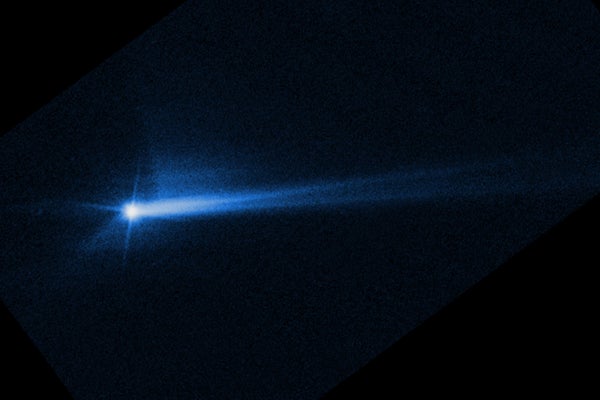
Humans have for the first time proven that they can change the path of a massive rock hurtling through space. NASA has announced that the spacecraft it slammed into an asteroid on 26 September succeeded in altering the space rock’s orbit around another asteroid — with better-than-expected results.
Agency officials had estimated that the Double Asteroid Redirection Test (DART) spacecraft would ‘nudge’ the asteroid Dimorphos closer to its partner, Didymos, and cut its orbit time around that rock by 10–15 minutes. At an 11 October press conference, researchers confirmed that DART in fact cut the orbit time by around 32 minutes.
Neither asteroid was a threat to Earth, but the agency tested the manoeuvre on them to prove that humanity could, in principle, deflect a worrisome space rock heading for the planet.
On supporting science journalism
If you're enjoying this article, consider supporting our award-winning journalism by subscribing. By purchasing a subscription you are helping to ensure the future of impactful stories about the discoveries and ideas shaping our world today.
“This is a watershed moment for planetary defence, and a watershed moment for humanity,” said NASA administrator Bill Nelson.
Tracking the aftermath
Determining whether the mission succeeded relied on more than a half dozen telescopes around the world. Ground-based optical telescopes can’t resolve Didymos and Dimorphos, which are millions of kilometres from Earth and only a few hundred metres across; they instead see the pair as a single point in the night sky. But the telescopes can measure dips in brightness as Dimorphos cycles in front of and behind Didymos. Observers tracked these movements and compared them to pre-collision orbit times to tabulate DART’s impact.
Independently, a pair of radar facilities — Goldstone Observatory in Fort Irwin, California, and Green Bank Observatory, in West Virginia — turned their dishes to the asteroid pair. Unlike optical telescopes, planetary radar can discern the two asteroids as distinct objects, allowing astronomers to view their respective positions and estimate Dimorphos’s orbit time around Didymos.
Both sets of observations agreed that DART’s impact knocked Dimorphos tens of metres closer to its companion and cut its cycle time to around 11 hours and 23 minutes.
Although the orbit reduction is larger than expected, it still falls within the range of possibilities that scientists modelled. Researchers think the manouevre succeeded to the extent that it did because Dimorphos is more a loose collection of rocks than a solid chunk that would be harder to deflect. Another reason for the dramatic orbit change is that when DART hit, a lot of debris shot out from the asteroid into tails, each one thousands of kilometres long, and their recoil probably accentuated DART’s impact, researchers said at the press conference.
“We have a lot of work ahead of us in order to really understand what happened,” said Tom Statler, a DART programme scientist at NASA’s headquarters in Washington DC.
Saving Earth
Scientists will continue to observe the asteroid couplet in the months to come, hoping to understand more about the shape of Dimorphos’s new orbit and whether DART’s impact introduced a ‘wobble’ to the asteroid. With the help of images from LICIACube — the Italian Space Agency’s probe that trailed DART and then flew by to capture the impact — scientists hope to learn more about the properties of the debris ejected.
But the final postmortem for the mission won’t be complete for the better part of a decade. Launching in its wake, the European Space Agency’s Hera mission — currently slated for an October 2024 liftoff — should arrive at Dimorphos in 2027, to observe the aftermath of DART’s impact.
For now, the results indicate that the US$330-million DART mission was a success. But defending Earth from future impacts requires a few things, researchers say: knowing the locations and properties of any dangerous space rocks, and having enough time to act. DART launched in November last year and took about 10 months to hit its target.
If a threatening asteroid really were headed towards Earth, said Nancy Chabot, a planetary scientist and the DART coordination lead at Johns Hopkins University Applied Physics Laboratory in Laurel, Maryland, a mission would need to launch years in advance to deflect it safely. “Warning is really key here,” she said, adding that even space rocks larger than the 160-metre-wide Dimorphos might be dealt with given enough planning and time.
This article is reproduced with permission and was first published on October 11 2022.