
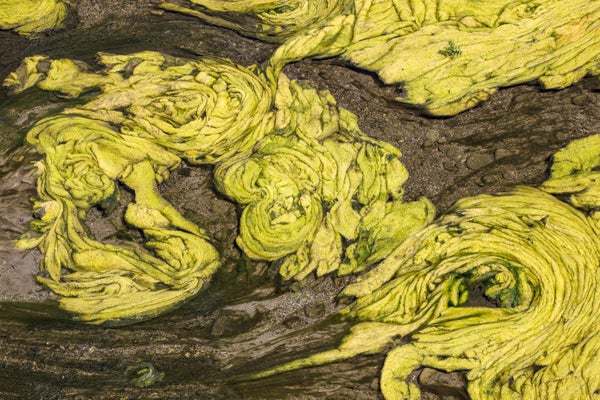
A river's colors hold clues to what flows in its water, from soft-green algae to yellow-brown mud. Human eyes might miss subtle shifts in these shadings, but satellites can detect them—and researchers can use them to track large-scale changes and potentially spot signs of trouble.
A team led by University of Pittsburgh environmental scientist John R. Gardner analyzed 234,727 satellite images, covering 67,000 miles of U.S. rivers over 35 years, for a study published in Geophysical Research Letters. The researchers isolated the main light wavelength each river reflected, transforming shifting colors into grids of numbers. “It's a very novel approach,” says Carl Legleiter, a U.S. Geological Survey scientist, who was not involved in the study.

Credit: John R. Gardner (map) and Amanda Montañez (color time lines); Source: “The Color of Rivers,” by John R. Gardner et al., in Geophysical Research Letters, Vol. 48; December 6, 2020
On supporting science journalism
If you're enjoying this article, consider supporting our award-winning journalism by subscribing. By purchasing a subscription you are helping to ensure the future of impactful stories about the discoveries and ideas shaping our world today.
Gardner's group found sediment-laden yellow (56 percent) and algal green (38 percent) dominated the country's rivers. A third of them had changed color over the past few decades, with the fastest shifts often near sediment-trapping dams. This effect is clear and striking, says Illinois State University environmental scientist Catherine O'Reilly, who was not involved in the study but currently collaborates with two of the authors.
Western U.S. river colors mostly moved toward the blue end of the spectrum over time, suggesting they carried less sand and silt. But many rivers in the Northeast showed a “redshift” that made them appear more yellow, indicating lower water levels or increasing sediment. Gardner says this divergence suggests that regional factors, such as land-use patterns and watershed-management practices, influence long-term river hue shifts. (Some rivers shifted against these trends because of local influences.)
“We also found very distinct seasonal patterns,” Gardner says. Many of the nation's rivers turn yellower in spring or summer as peaking rainfall muddies the waters. But the timing also depends on geography and on human activity such as agriculture.
Using satellites to gauge changes in river composition could warn scientists when environments begin to fall out of balance, the researchers say. Legleiter is particularly interested in watching for harmful algal blooms. “A lot of times with environmental change, we don't see it until too late,” O'Reilly adds. “But with satellites, we could start to see changes early on.”