
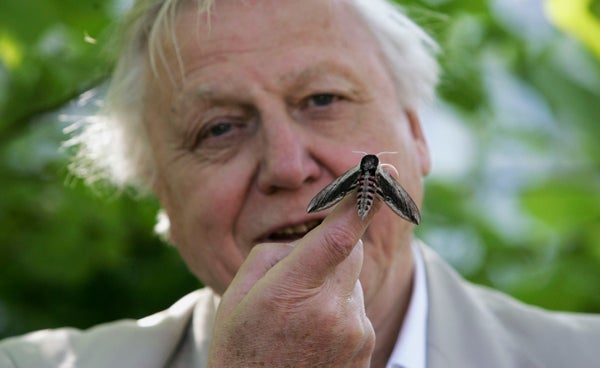
David Attenborough, perhaps best known as the soft-spoken narrator and documentarian who has guided millions of TV viewers through the awe-inspiring wonders of the natural world, turns 100 today.
“I had rather thought that I would celebrate my 100th birthday quietly, but it seems that many of you have had other ideas,” Attenborough, who among his many television exploits narrated the ground-breaking series Planet Earth, Blue Planet and Life, said in a message published by the BBC. “I’ve been completely overwhelmed by birthday greetings from preschool groups to care home residents and countless individuals and families of all ages.”
Among the many expressions of birthday wishes was the naming of a tiny parasitic wasp after him. (It is far from the first creature to be named after Attenborough—the list includes a genus of marine reptiles from the Early Jurassic, a critically endangered echidna, multiple plants, insects and spiders, and a ghost shrimp).
On supporting science journalism
If you're enjoying this article, consider supporting our award-winning journalism by subscribing. By purchasing a subscription you are helping to ensure the future of impactful stories about the discoveries and ideas shaping our world today.
Attenborough rose to the highest ranks of the British Broadcasting Corporation (BBC) but ultimately discarded the C-suite in favor of the sandy beaches, tropical rainforests and coral reefs from which he made his beloved dispatches to TV viewers. He has won numerous awards for his documentary work, including four Emmys and British Academy of Film and Television Arts awards for programs in black and white, color, HD, and 3D, but he has always remained grounded, his former colleagues and friends say.
“He’s just a normal bloke, basically—very down-to-earth,” Gavin Thurston, a cinematographer who has worked with Attenborough on numerous series, told Scientific American. “Who you see on TV is who he is.... He’s just genuinely interested in everything.”
In 2015 I myself met and interviewed Attenborough while working for the website Live Science. Then aged 89, he said his favorite experience to date was his first time diving on a coral reef. “The sensation of being able to move without any physical effort at all [and seeing] the most extraordinary crustaceans, invertebrates of all kinds and nudibranchs [sea slugs] ... the colors, the way they move—it’s just mind-blowing,” he told me.
Born May 8, 1926, near London to Frederick and Mary Attenborough, he had two brothers, including the actor Richard Attenborough. As a child, David loved collecting fossils and animals. When he was around age 11, he supplied newts to the zoology department of his father’s university for a small fee. He later studied geology and zoology at Cambridge University.
Attenborough joined the BBC as a TV producer in 1952. In 1954 he launched the series Zoo Quest with reptile expert Jack Lester, which filmed animals in zoos and in the wild. He rose to eventually become director of television programming from 1968 to 1972. Attenborough was even considered for the job of director general of the network, but he resigned so he could devote himself to writing and producing television programs full-time.

David Attenborough with an orangutan and her baby at London Zoo, April 1982.
Mirrorpix/Contributor/Getty Images
Over the course of the following decades, he wrote and narrated a series of beloved nature documentaries, including the Life series, Blue Planet, and the ground-breaking Planet Earth series. He has narrated numerous other docuseries, including the BBC’s Wildlife on One and Blue Planet II, and Netflix’s Our Planet, as well as the 2025 film Ocean with David Attenborough.
He has also written several books, including the 2002 memoir Life on Air: Memoirs of a Broadcaster.
Despite his fame and accolades, Attenborough retains a humble persona. He often flies coach on airplanes, even as he has gotten older, Thurston says. And he always offers to help carry crewmembers’ bags.
But the documentarian also has very high standards and can be imposing at times. “He just walks into a room and you know you’re in the presence of a powerful man,” says Keith Scholey, co-director of Silverback Films, who worked with Attenborough for more than 45 years, many of them at the BBC. “His work ethic is phenomenal,” and he expects the best of everyone around him, Scholey says.
Attenborough has historically avoided politics in his work, preferring to only comment on topics he feels completely confident in. “He would never be outspoken about something unless he could categorically, scientifically, argue it as correct,” Thurston says.
“Some people used to criticize David, saying he didn’t say enough [on environmental issues] in the early years,” Scholey says. “Before he started speaking about stuff, he wanted to be completely certain that it was right.”
In recent years Attenborough has taken a stronger stance on topics such as climate change and biodiversity loss. In 2021 he told COP26 climate summit attendees, “Our burning of fossil fuels, our destruction of nature, our approach to industry, construction and learning, are releasing carbon into the atmosphere at an unprecedented pace and scale.”
Still, Attenborough is optimistic that humans can do the right thing.
“He’s never wagged the finger and told us, ‘Right, you must do this, or you mustn’t do that.’ What he’s done is he’s shown us the wonders of the natural world,” Thurston says. “He’s opened doors for us, and he’s impassioned us with all these amazing stories [of] species and places.”