
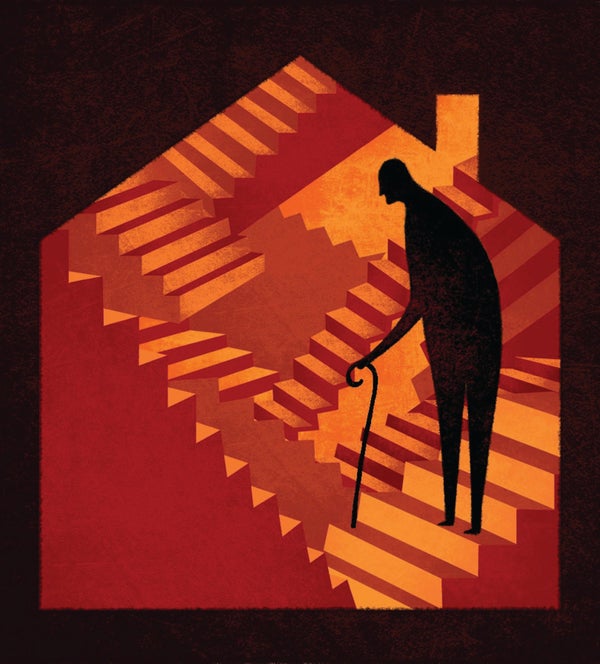
In the senior community where my mom lives, death is a frequent visitor. When we talk about a recent loss, the story is often the same: her neighbor fell, and things got worse from there. Falls are the seventh-leading cause of death for adults aged 65 and older in the U.S., and their prevalence has jumped more than 30 percent in recent years, according to a 2018 report from the U.S. Centers for Disease Control and Prevention. Even when a spill doesn't cause serious injuries, it can be the beginning of the end for elderly adults, explains Patricia Dykes, who studies fall prevention at Brigham and Women's Hospital in Boston. “They become afraid to move. They'll think, ‘Maybe I shouldn't walk so much.’ Then they get weaker, and their balance gets poorer.” This starts a spiral of more falls, increased injuries and worsening health. “Fear of falling prevents older people from doing the things that would prevent falls,” she says.
There are likely many reasons for the rise in fall-related deaths. For one thing, more people are surviving heart disease, cancer and strokes and living into their 80s and 90s with impairments and chronic conditions that make them unsteady, says epidemiologist Elizabeth Burns of the CDC, who co-authored the 2018 report. “We also know that Americans use more medications than they used to,” she says. Polypharmacy—taking four or more medications—increases the chance of falling. So does taking a drug that impacts the central nervous system, such as an opioid or antidepressant. Age-related changes in eyesight, cognition, muscle strength and balance also raise risk.
But experts insist that falling is not inevitable. Targeted exercises, modified drug regimens and fixing vision problems can reduce the risk. New technology may help, including smartphone apps that analyze gait, as well as AI tools that alert busy health-care providers to fall risks among their patients.
On supporting science journalism
If you're enjoying this article, consider supporting our award-winning journalism by subscribing. By purchasing a subscription you are helping to ensure the future of impactful stories about the discoveries and ideas shaping our world today.
Probably the single most important thing an individual can do is to work on lower body strength, balance and gait. “Just like you need to eat every day, you need to exercise every day,” Dykes says. The Otago exercise program, developed in New Zealand, has reduced falls by 35 percent among high-risk elderly when overseen by physical therapists. Many studies have looked at combining exercise programs with other changes, such as cutting back on certain medications and reducing household hazards. A 2018 review of 62 studies found that, on average, such multifaceted approaches cut the rate of falls by 23 percent.
Such results can be hard to achieve in the messy real world, however. Researchers had high hopes for the STRIDE study, which tracked 5,451 people aged 70 or older at 86 primary care practices across the U.S. All participants were at risk for falling. Half agreed to target one to three specific risk factors, whereas half were given basic information about preventing falls. But the results, published in 2020, showed no significant difference between the groups. Dykes, who was a co-author, says people may have avoided selecting factors that would have mattered most. For instance, “a lot of older people don't want to take away scatter rugs [a tripping hazard] or add grab bars in the shower and next to the toilet. They want their house to look like a home.” With medications, it takes time and patience to persuade a patient to stop a drug they may have relied on for years. Some drugs that raise the odds of falling are used for conditions that impact fall risk if left untreated. “It makes for complicated decision-making for doctors,” Burns says.
Given such challenges, several new efforts focus on offering better support to health-care providers. The CDC's STEADI program, for instance, gives doctors a suite of tools to identify and reduce fall risks among patients. In a large study in New York State, it cut the chances of a fall-related hospitalization by 40 percent. Dykes and her colleagues are now testing Web-based tools that scan patient electronic health records for fall risk factors and use algorithms to suggest remedies.
Technology can also help raise a person's own awareness of potential problems. Apple is about to introduce a “walking steadiness” rating to its iPhone Health app. It measures stability based on walking speed, step length, step symmetry, and an indicator of shuffling. Users with low ratings can access Otago-based exercise videos and other tools. As long as it doesn't scare users into retreating to their couches, the app and similar tools could help put more folks on a safer footing.