Deep-Sea Sponge Skeletons Could Inspire Better Bridges

The creature’s structure resists buckling and could lead to stronger and more durable architecture

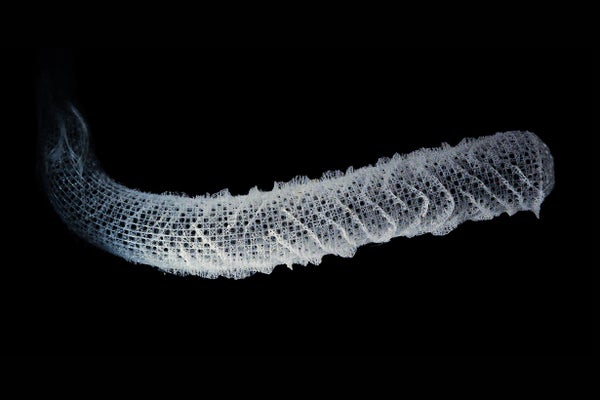
Skeleton of Euplectella aspergillum

Skeleton of Euplectella aspergillum, a deep-water marine sponge whose structure resists buckling.

Join Our Community of Science Lovers!

Glassy marine sponges have quite a “backbone.” According to a new study, one species’ intricate skeletal structure is impressively strong, outperforming comparable configurations humans use for lattice-style bridges.

Harvard University researchers hoping to build stronger and lighter structures looked for inspiration in the deep-water sponge Euplectella aspergillum, whose tubelike skeleton forms a square grid with diagonal reinforcements. They compared it with existing human-made lattice structures, such as those used in covered-bridge designs since the 1800s, stress-testing simulated objects and even crushing 3-D-printed miniature replicas of each of them—and the sponge structure came out on top. These results are perhaps not surprising, considering E. aspergillum’s millions of years of evolution, the researchers say. The new work was detailed in September in Nature Materials.

“In many fields, such as aerospace engineering, the strength-to-weight ratio of a structure is critically important,” said James Weaver, a co-author of the study and an engineer at Harvard, in a recent statement about the research. “This biologically-inspired geometry could provide a roadmap for designing lighter, stronger structures for a wide range of applications.”


On supporting science journalism

If you're enjoying this article, consider supporting our award-winning journalism by subscribing. By purchasing a subscription you are helping to ensure the future of impactful stories about the discoveries and ideas shaping our world today.


Searching out resilient sponges and other natural architects could bridge the gap to making ever more impressive structures.

Science in Images is a new category of articles featuring photographs and videos from all the disciplines of science. Click on the button below to see the full collection.

Science in Images

Sarah Lewin Frasier is a senior editor at Scientific American. She plans, assigns and edits the Advances section of the monthly magazine, as well as editing online news, and she launched Scientific American’s Games section in 2024. Before joining Scientific American in 2019, she chronicled humanity’s journey to the stars as associate editor at Space.com. (And even earlier, she was a print intern at Scientific American.) Frasier holds an A.B. in mathematics from Brown University and an M.A. in journalism from New York University’s Science, Health and Environmental Reporting Program. She enjoys musical theater and mathematical paper craft.

More by Sarah Lewin Frasier

It’s Time to Stand Up for Science

If you enjoyed this article, I’d like to ask for your support. Scientific American has served as an advocate for science and industry for 180 years, and right now may be the most critical moment in that two-century history.

I’ve been a Scientific American subscriber since I was 12 years old, and it helped shape the way I look at the world. SciAm always educates and delights me, and inspires a sense of awe for our vast, beautiful universe. I hope it does that for you, too.

If you subscribe to Scientific American, you help ensure that our coverage is centered on meaningful research and discovery; that we have the resources to report on the decisions that threaten labs across the U.S.; and that we support both budding and working scientists at a time when the value of science itself too often goes unrecognized.

In return, you get essential news, captivating podcasts, brilliant infographics, can't-miss newsletters, must-watch videos, challenging games, and the science world's best writing and reporting. You can even gift someone a subscription.

There has never been a more important time for us to stand up and show why science matters. I hope you’ll support us in that mission.

Thank you,

David M. Ewalt, Editor in Chief, Scientific American

Subscribe