
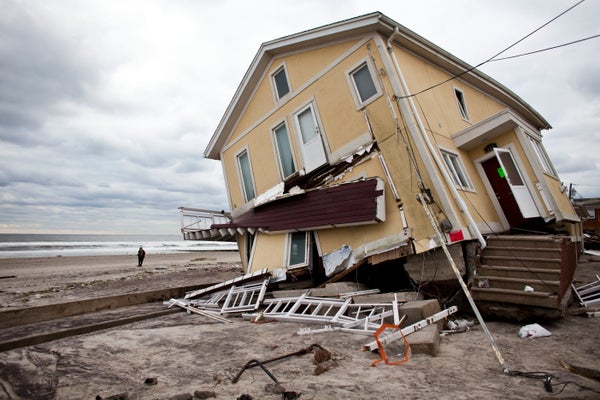
CLIMATEWIRE | Local property values and business development increased after a large government program was used to purchase flood-damaged homes in the wake of one of the nation's most expensive hurricanes.
The findings by researchers who studied a New York home buyout program offer an economic endorsement of the practice of acquiring damaged homes and then razing or redeveloping them to avoid using public funds to repeatedly fix houses in high-risk flood zones. The report comes as scientists say climate change is intensifying downpours and other causes of inundation.
Researchers with Resources for the Future, an economic think tank focused on environmental policies, took the unusual step of analyzing local property values and business development following the purchase of 1,300 homes by the NY Rising Buyout and Acquisition Program after Hurricane Sandy devastated parts of the East Coast in 2012. The program generated nearly $5 billion in benefits through higher property values, job creation and enhanced resilience, the researchers found.
On supporting science journalism
If you're enjoying this article, consider supporting our award-winning journalism by subscribing. By purchasing a subscription you are helping to ensure the future of impactful stories about the discoveries and ideas shaping our world today.
Most studies of home buyout programs have assessed how much flood damage was averted by demolishing houses and leaving the lots vacant.
“This kind of program is an effective disaster recovery program,” said Penny Liao, a co-author and economist at Resources for the Future. “A lot of times local communities are wary of these programs. But in general we find these programs do create positive economic impacts."
The buyouts resulted in economic benefits that were nearly eight times as much as the $640 million cost of the program, the researchers estimated.
The report, which is described as a working paper, stopped short of saying the program resulted in “gentrification” — when wealthier people move into a neighborhood and displace longtime residents — because homeownership rates are high in the affected areas and few renters were displaced. The program mostly focused on homes in Staten Island and Long Island.
“The economic changes that we see are consistent with the neighborhoods undergoing gentrification,” Liao said, before adding, “The positive impact probably dominates because most of the homes in these neighborhoods are owner-occupied.”
The New York program was unusual because roughly half the 1,300 properties were converted to open space and the other half were sold for redevelopment. Most buyout programs involve only creating open space as they prioritize eliminating flood damage.
New York paid for the program primarily with the $4.5 billion in disaster aid the state received from the U.S. Department of Housing and Urban Development after Sandy, which NOAA ranks as the fifth-costliest disaster in U.S. history, with $87 billion in damage.
The researchers analyzed neighborhoods immediately around the 1,300 properties — many of which were clustered — and found property values and business development increased by a greater margin than in nearby areas.
The report says that a single state buyout “significantly increases property values” within a 1-kilometer radius. The buyouts also had “positive impacts on nearby business establishments and urban amenities.”
Properties that the state bought and sold to a developer generally produced larger benefits than properties the state converted to open space, the researchers found.
New York targeted highly damaged homes in ravaged areas for buyouts. The communities are mostly middle-income or upper-middle-income parts of Staten Island and Nassau and Suffolk counties and exclude wealthy areas on Long Island’s North Shore and East End, which were not heavily damaged.
The report expands on previous research about buyout programs and Sandy’s effect on the New York City area.
Previous studies have shown that the storm decreased property values throughout the region in part by raising awareness of flood risk. Those studies did not analyze the New York buyout program.
Other studies have shown that buyouts are effective at reducing flood damage but create community concerns by resulting in conspicuous vacant lots and lost revenue from property taxes.
Reprinted from E&E News with permission from POLITICO, LLC. Copyright 2022. E&E News provides essential news for energy and environment professionals.