
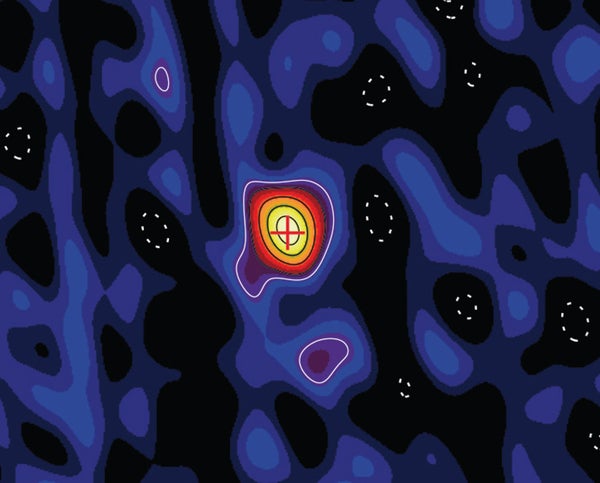
Looking at the very distant, very ancient universe, we find quasars—extremely bright cosmic lights powered by gas falling onto supermassive black holes. But how could black holes have been able to grow so large in such a short time after the big bang? Theory holds that a black hole is the product of a collapsed elderly, burned-out star. So it doesn't make sense to see such massive ones so early in the timeline of our universe.
Unless, of course, there is another way for black holes to arise. Instead of being born from dying stars, could the seeds of the most ancient of these humongous black holes have collapsed directly from the glass clouds in the early universe? An answer could be coming soon. The James Webb Space Telescope, which is due to launch in 2019 and will be able to peer farther back in spacetime than any previous instrument, could find proof of such direct-collapse black holes. Find out how in our cover story, “The First Monster Black Holes,” by astrophysicist Priyamvada Natarajan.
If we first viewed our planet from the perspective of outer space, it's been said, we would have named it “Ocean” instead of “Earth.” Ocean health is intimately linked to the well-being of countless species, which is why more than 15,000 marine protected areas exist worldwide. The regulations often permit oil drilling and commercial fishing, however—a cause for concern, reports journalist Olive Heffernan in “Troubled Waters.” Read it to find out how nations need tougher rules close to shore to improve fisheries and biodiversity.
On supporting science journalism
If you're enjoying this article, consider supporting our award-winning journalism by subscribing. By purchasing a subscription you are helping to ensure the future of impactful stories about the discoveries and ideas shaping our world today.
I suspect I'm far from alone in my dismay at the increasingly coarse, antagonistic tone of U.S. political discourse. Worse, the rise of polarization is not just unpleasant. It is also raises the question of “what happens in our minds—and to our minds—” when we argue only to win, write cognitive researchers Matthew Fisher, Joshua Knobe, Brent Strickland and Frank C. Keil. Their article spells out “The Tribalism of Truth.” Truth, of course, relies on data—which haven't always been in plentiful supply from the Food and Drug Administration. In “[Redacted],” journalist Charles Seife explores how drug data have gone missing vis-à-vis big pharma. In this, the “information age,” we as patients—and citizens in general—need all the transparency we can get.