
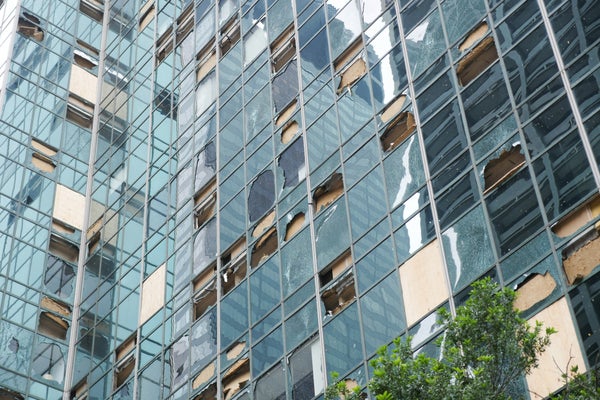
CLIMATEWIRE | Back-to-back disasters rocked Houston last year, when a powerful derecho struck the city in May, followed by Hurricane Beryl in July. Both events brought gale-force winds to the densely built downtown, with gusts exceeding 90 miles per hour.
But after the storms, researchers noticed something strange. The derecho caused more damage than the hurricane to Houston’s tallest buildings.
Now, scientists say there’s a need for more research on the impacts of powerful downbursts in urban centers. That’s especially true for places like Houston, the Gulf Coast’s largest city, where thunderstorms and hurricanes can both wreak havoc.
On supporting science journalism
If you're enjoying this article, consider supporting our award-winning journalism by subscribing. By purchasing a subscription you are helping to ensure the future of impactful stories about the discoveries and ideas shaping our world today.
In a new study, published Friday in the scientific journal Frontiers in Built Environment, researchers from Florida International University demonstrated that different kinds of storms — which produce distinct wind patterns — can pose different threats to tall buildings.
Both hurricanes and derechos can produce high-speed winds. But derechos — long-lasting wind storms often associated with bands of thunderstorms — have unique traits. They’re often characterized by sudden bursts of winds that move in straight lines, often causing damage that radiates outward in a single direction.
The researchers compared the damage caused by last year’s storms on several of Houston’s tall buildings, each at least 600 feet tall. These include the Chevron Building Auditorium, Wells Fargo Plaza, Enterprise Plaza, Wedge International Tower and the Total Energies Tower.
Each of these buildings is designed to withstand gusts up to 150 mph — yet many still sustained significant damage, particularly during the derecho. The researchers noted that an assessment of 18 buildings revealed more than 3,000 broken windows during the storm. Hurricane Beryl, on the other hand, caused significantly less glass damage than the derecho.
The researchers wanted to know why there was such a difference between the two storms. So they conducted a series of experiments in a special wind chamber housed at FIU, altering the airflow to simulate the patterns of derechos versus hurricanes. Model buildings inside the chamber helped them evaluate the impacts of the strong winds on the built environment.
They found that derecho winds can produce unique forces compared with hurricanes, including stronger suction on the walls of city buildings, allowing them to dislodge glass panels and shatter windows. The findings suggest that even buildings designed for strong winds aren’t necessarily resilient for all kinds of storms.
“Accounting for the unique effects of downbursts and thunderstorm winds in derechos is essential in urban planning and building design, to protect tall buildings against damage,” Omar Metwally, a Ph.D. student at Florida International University and the study’s lead author, said in a statement. “Current construction guidelines for facades should be re-evaluated to reflect this.”
The findings are an important data point in today’s changing climate, where extreme weather events are steadily worsening.
Numerous studies suggest hurricanes are growing more intense as the climate warms. Meanwhile, other research indicates certain regions of the country may see more thunderstorms as temperatures rise. And damaging straight-line winds are already intensifying in some places.
Worse storms likely would exacerbate an already challenging situation.
Thunderstorms caused more damage in the U.S. last year than any other type of extreme weather. A report from the reinsurance company Munich Re found that severe thunderstorms were responsible for $45 billion in damages in the first half of the year alone. And NOAA datasets suggest that severe storms accounted for half the country’s billion-dollar damages over the last 45 years.
Reprinted from E&E News with permission from POLITICO, LLC. Copyright 2025. E&E News provides essential news for energy and environment professionals.