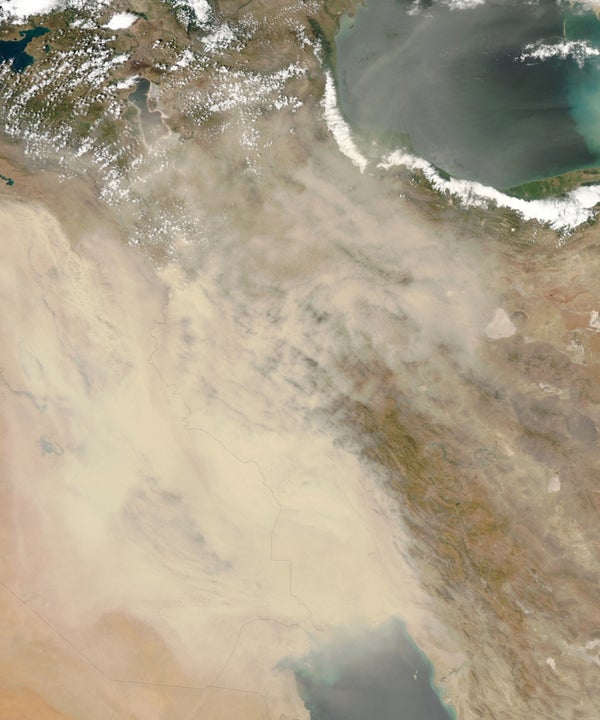
Desert storm: Satellite spots dust storm that choked Iraq
A vicious sandstorm blew across Iraq on Sunday as NASA's Earth-observing Aqua satellite passed 438 miles (705 kilometers) overhead.
On supporting science journalism
If you're enjoying this article, consider supporting our award-winning journalism by subscribing. By purchasing a subscription you are helping to ensure the future of impactful stories about the discoveries and ideas shaping our world today.
A vicious sandstorm blew across Iraq on Sunday as NASA's Earth-observing Aqua satellite passed 438 miles (705 kilometers) overhead.
The multi-day storm caused health problems, delayed flights and scuttled some of U.S. Vice President Joe Biden's plans during his visit to the country. An Iraqi Health Ministry doctor told Reuters that it was "the worst dust storm we have ever had in Iraq." In neighboring Iran, the storms caused the government to shutter businesses for two days this week, according to the New York Times.
In this satellite image, the heart of the storm hovers over the Iraq–Iran border near the center of the photograph. The southern end of the Caspian Sea is visible at the top of the image; the tip of the Persian Gulf is below.
KVAL.com, the Web site of the Eugene, Ore., CBS affiliate, has an embedded reporter in Iraq who filed astonishing photographs of the same scene both during the sandstorm and on a clear day, showing the dramatic orange glow imparted by the ubiquitous dust.
It’s Time to Stand Up for Science
If you enjoyed this article, I’d like to ask for your support. Scientific American has served as an advocate for science and industry for 180 years, and right now may be the most critical moment in that two-century history.
SciAm always educates and delights me, and inspires a sense of awe for our vast, beautiful universe. I hope it does that for you, too.
If you subscribe to Scientific American, you help ensure that our coverage is centered on meaningful research and discovery; that we have the resources to report on the decisions that threaten labs across the U.S.; and that we support both budding and working scientists at a time when the value of science itself too often goes unrecognized.
In return, you get essential news, captivating podcasts, brilliant infographics, can't-miss newsletters, must-watch videos, challenging games, and the science world's best writing and reporting. You can even gift someone a subscription.
There has never been a more important time for us to stand up and show why science matters. I hope you’ll support us in that mission.