
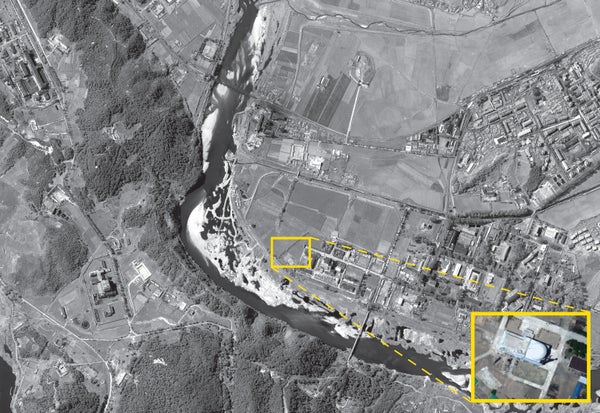
The year is 2030. After years of wrangling, the North Korean leadership agrees to stop making weapons-grade plutonium and to destroy its stockpiles. Officials invite inspectors to watch them load this nuclear fuel into reactors and transform it into a form useless for bombs. Yet the North Koreans secretly divert some plutonium and fill the reactor instead with lower-grade uranium. The uranium emits radiation, including neutrinos and their antimatter counterparts, antineutrinos—harmless and light subatomic particles that pass ghostlike even through lead or rock. Suspecting a ruse, the international authorities park an SUV-sized device near the North Korean reactor. Within months they confirm the deception via a telling pattern of antineutrinos streaming from the facility.
That scenario could become reality in coming years as tools of particle physics are used to combat illicit nuclear programs. A new proposal, detailed recently on the preprint server arXiv.org, describes how to build an antineutrino detector that could, over the course of a few months, determine if weapons-grade fuel is being used in a reactor. The need for such detection methods has become more urgent. North Korea has advanced its missile technology, and Iran has developed the capacity for its own nuclear weapons program, making verification a key issue. In March, Secretary of State Rex Tillerson called for a “different approach” to stymieing North Korea's nuclear aspirations, saying that diplomatic pressure alone had failed.
Antineutrinos are a by-product of the fission in a nuclear reactor, in which an atomic nucleus of a radioactive element such as plutonium splits into lighter elements. One type of radioactivity, called beta decay, releases either a positron and a neutrino or an electron and an antineutrino. That antineutrino is the “tell” for a reactor because only the radioactive elements in nuclear fuel emit lots of them at a steady rate.
On supporting science journalism
If you're enjoying this article, consider supporting our award-winning journalism by subscribing. By purchasing a subscription you are helping to ensure the future of impactful stories about the discoveries and ideas shaping our world today.
Antineutrino-based nuclear surveillance is the impetus for a U.S.-led project called WATCHMAN (for WATer CHerenkov Monitor for ANtineutrinos). A WATCHMAN device would consist of a tank containing thousands of tons of gadolinium-doped water and could theoretically detect antineutrinos from an illicit reactor up to 1,000 kilometers away. It is hard to diplomatically ask a wary nation to let inspectors build giant water tanks close to heavily guarded facilities, so such detection distances are handy.
When an antineutrino hits a proton—a hydrogen nucleus in a water molecule in the giant tank—it transforms that proton into a neutron and a positron. The positron moves so fast that it emits light called Cherenkov radiation, the optical equivalent of a sonic boom produced when a charged particle moves faster than the speed of light through some substance. Nothing goes faster than light moving through a vacuum, but in another medium—such as water, glass or air—light moves slower and can be outpaced. Thus, a positron from an antineutrino will create a flash of light in a WATCHMAN tank. Meanwhile the gadolinium in the water will sop up the neutron, a process that emits a second flash. This characteristic double flash reveals the presence and direction of a nuclear reactor.
WATCHMAN can indicate whether a reactor is active and where it is but not the precise mix of fuel, such as highly enriched plutonium and uranium. Patrick Jaffke, a postdoctoral researcher at Los Alamos National Laboratory and co-author of the new proposal, suggests a small version that could be placed close to a reactor to determine the type of nuclear fuel within by analyzing the activity of antineutrinos. His design would measure the spectrum and shape of the initial Cherenkov flash and thus the energy of the progenitor antineutrinos from the positrons. By charting the energy distribution of the detected positrons, an inspector could estimate how much of the total antineutrino emission was from a given fuel type in a reactor's core.
Instead of water, Jaffke suggests using plastic or another proton-packed hydrocarbon to boost the chances for antineutrino collisions and to reduce a device's size by orders of magnitude. Such a detector could then be placed within dozens of meters of a reactor.
Although such a detector would be smaller, there would still be the issue of background noise. Cosmic rays, for example, can create neutrons that look similar to ones from neutrino reactions. Putting the antineutrino detector five to 10 meters underground and fairly close to a reactor might solve this problem, says Steven Dazeley of Lawrence Livermore National Laboratory, who led a 2016 analysis of noise issues facing WATCHMAN. Additional shielding around the device could also help.
There are other ideas for devices that need little or no shielding. And help could come from several groups around the world working on neutrino- and antineutrino-detection technologies for physics research.
“There's been a longtime search for a practical use of antineutrinos,” Jaffke says. “That's one of the coolest aspects” of using the particles to detect weapons-grade nuclear fuel. Let's hope it doesn't find any.