
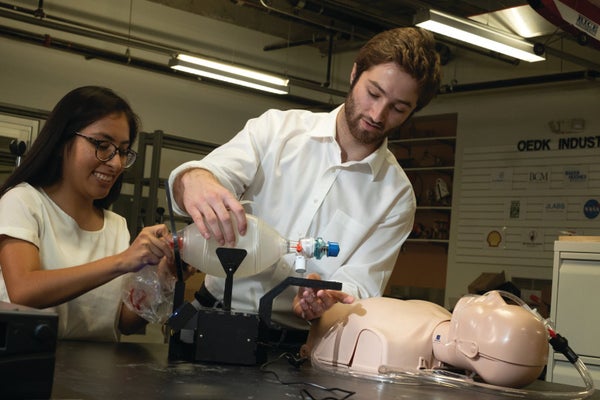
When someone has serious trouble breathing, care providers often use a mask with an attached bag—which has to be manually squeezed—to pump air into the lungs until a patient can be put on an automatic ventilator.
In many highly developed regions, this “manual bag valve mask” is usually just a short-term, stopgap measure. But in places with limited medical staff and few—if any—ventilators, “it's up to you to keep your family members alive” by squeezing the bag for much longer periods, says Rohith Malya, director of emergency medicine at Thailand's Kwai River Christian Hospital. The facility treats many refugees from the Rohingya crisis in Myanmar (formerly Burma), just across the nearby border, Malya says. He sees people with pneumonia and other treatable illnesses die because family members are too exhausted to continue “bagging.” But now he has partnered with a design team of Rice University undergraduates to create a device that automatically compresses the bag.
The team hopes the $117 machine, called the AutoBVM (short for automated bag valve mask), could be used in disaster settings and emergency transport until a ventilator becomes available or even as an alternative to one. The AutoBVM—which plugs into a standard wall outlet—consists of two triangular plastic “pushers” attached to a geared frame and powered by a motor. Creating a battery-powered version is a priority for future work, says Carolina De Santiago, a bioengineer on the Rice team.
On supporting science journalism
If you're enjoying this article, consider supporting our award-winning journalism by subscribing. By purchasing a subscription you are helping to ensure the future of impactful stories about the discoveries and ideas shaping our world today.
A prototype of the AutoBVM ran for up to 11 hours in laboratory tests before overheating, on settings typically used for adult patients, De Santiago says. It has not yet been tested in people. Malya plans to work with a team of graduate students to create another version with a different motor that could increase its operating time. He also hopes to improve the device's seals and filtration system to make it suitable for disaster situations and hot, dusty field environments. He plans to test it in patients at Kwai River Christian Hospital next year.
Many people worldwide lack adequate access to ventilators, which can cost as much as $100,000, says Abdullah Saleh, who directs the University of Alberta's Office of Global Surgery and was not involved in the work. Bag valve masks are “ubiquitous across even remote and low-resource areas,” he notes. “Automating a way to deliver air through them could address a real need.”