
In the last hours of the last day of February 2021, a 29-pound chunk of space rock ripped into Earth's upper atmosphere at roughly 8.5 miles per second. As it streaked through the stratosphere, the heat and friction of entry charred its exterior a deep black. Bits of soft rock sloughed off in the blaze, and a huge fireball briefly flared like a torch in the night sky.
By the time the largest piece of debris landed abruptly in a driveway in Winchcombe, England, it weighed only 11.3 ounces. Scientists snagged the rocky, powdery material within 12 hours, making it among the freshest meteorites ever studied. “It's pretty much as pristine as we're going to get,” says Ashley King, a planetary scientist at the Natural History Museum in London.
The Winchcombe meteorite belongs to a rare class of space rocks known as carbonaceous chondrites. These volatile bodies are helping researchers piece together one of the biggest puzzles on Earth: where our planet's water came from. Researchers think some may have arrived on meteorites, but how much is hotly debated. Some argue that meteorites made it rain; others say their contribution may have been more like a drop in the bucket.
On supporting science journalism
If you're enjoying this article, consider supporting our award-winning journalism by subscribing. By purchasing a subscription you are helping to ensure the future of impactful stories about the discoveries and ideas shaping our world today.
Before Earth was a planet, it was a cloud of dust orbiting the young sun. Through a process called accretion, this dust condensed to form pebbles that collided and stuck together. The impacts produced increasingly large rocks, which eventually snowballed into a whole planet.
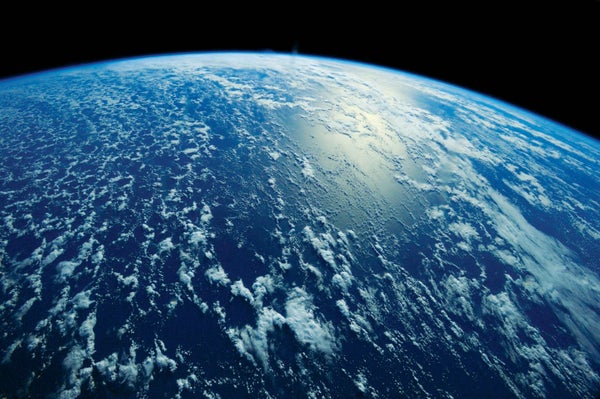
Early Earth was not the “pale blue dot” of today; its temperatures spiked to 3,600 degrees Fahrenheit, more than enough to boil any surface water off into space. Scientists once believed this meant the planet would have been bone-dry in its infancy, but recent research published in Nature suggests it might have been significantly wetter. After noting that numerous Earth-like exoplanets were blanketed with a hydrogen-rich atmosphere as they accreted, study co-author Anat Shahar, a geochemist at the Carnegie Institution for Science in Washington, D.C., and her colleagues simulated Earth's formation with such an atmosphere added. They discovered that, contrary to previous hypotheses, lots of water endured in the virtual planet's atmosphere and became encased inside its rocky mantle, even as magma rivers flowed freely across the outer crust.
Although this model suggests that considerable water could have been here since the planet formed, planetary geologists remain confident that a significant portion still came from beyond our atmosphere. “There's so much evidence,” Shahar says. “We can't argue against it.”
The “smoking gun,” King says, is hidden in Earth's hydrogen. Hydrogen exists on Earth in two stable “flavors,” called isotopes: regular hydrogen, which has a single proton for its nucleus, and deuterium, whose nucleus is made of one proton and one neutron. Water found in the mantle has about 15 percent less deuterium than seawater; that extra seawater deuterium most likely came from somewhere else.
Astronomers initially theorized that deuterium-rich water traveled to Earth on comets. Because they exist in the solar system's cold outer reaches, comets are extremely icy; up to 80 percent of their mass may be water. But in 2014 data from the European Space Agency's Rosetta mission showed that many comets' isotopic ratio is way off—they have far more deuterium than terrestrial water does. Scientists proposed another hypothesis: water surfed into our atmosphere on the solar wind, which pushes free-range hydrogen and oxygen molecules from space toward Earth. Many scientists maintain, however, that these molecules' deuterium ratio is far too low. “It's hard to explain the water budget from those sources,” says Megan E. Newcombe, a petrologist at the University of Maryland.
So where was the Goldilocks isotope ratio? Researchers finally hit the jackpot with asteroids—specifically, raw asteroid chunks called chondrites. Carbonaceous chondrites, which are named for their carbon content, are up to 20 percent water. “This doesn't mean that when you touch the meteorite, it's wet,” says Maria Valdes, a geologist at the Field Museum in Chicago. Instead they carry the atomic ingredients for water: a 2:1 hydrogen-to-oxygen ratio.
For a 2022 paper in Science Advances, King and his colleagues analyzed the Winchcombe meteorite using spectroscopy. They found that the meteorite's deuterium-to-hydrogen ratio matched Earth's oceans almost perfectly—an especially notable result given how quickly they collected it.
“Meteorites don't like the atmosphere,” says Denton Ebel, geology curator at the American Museum of Natural History. The minerals inside space rocks soak up water vapor like a sponge as soon as they hit the air. But because the Winchcombe sample was obtained within 12 hours of impact, it was much less contaminated with terrestrial water than most samples.
A few months after the Winchcombe analysis came out, a study by Newcombe and her team further strengthened carbonaceous chondrites' case. For that paper, published this year in Nature, they analyzed several newly fallen meteorites from a group called the achondrites. Unlike carbonaceous chondrites, these meteorites come from asteroids or other rocky bodies that have been partially melted by radiation and geologic processes. Newcombe and her co-authors found that the melting process stripped achondrites of their moisture, like baking cookie dough. “Everything we found, whether it came from the inner or the outer solar system, was really, really dry,” she says.
But this discovery doesn't mean carbonaceous chondrites were the planet's only water carriers, notes Laurette Piani, a cosmochemist at the University of Lorraine in France. “In my opinion, there are probably several sources for water on Earth,” she says. It would take an awful lot of meteorite impacts to account for the planet's oceans in chondrites alone, and carbonaceous chondrites are fairly rare today. Piani points out that roughly equal parts solar wind, comets, water bubbling up from the mantle and chondrites could be combined to match Earth's isotope balance. Whatever the exact recipe for Earth's water, investigating its origin will reveal more about how our planet formed and became the dynamic blue world we live in.