
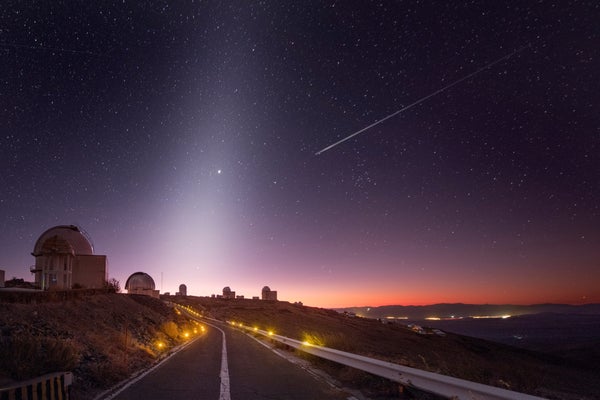
The earthshaking rumblings felt in Michigan last night weren't an earthquake, but rather vibrations from a booming noise caused by a meteor whizzing overhead, according to the National Earthquake Information Center (NEIC).
On Tuesday evening (Jan. 16), people in Ohio, Michigan and Ontario, Canada, were treated to the awe-inspiring view of a meteor streaking across the night sky. At 8:09 p.m. local time in southeastern Michigan, hundreds of people reported hearing a loud boom from the meteor and feeling the ground shake, according to the U.S. Geological Survey (USGS).
"People described it as a booming noise, and that's what the seismometers would have picked up," said John Bellini, a geophysicist at the NEIC in Golden, Colorado. [When Space Attacks: The 6 Craziest Meteor Impacts]
On supporting science journalism
If you're enjoying this article, consider supporting our award-winning journalism by subscribing. By purchasing a subscription you are helping to ensure the future of impactful stories about the discoveries and ideas shaping our world today.
It's not uncommon for non-earthquake vibrations to register on seismometers. For instance, the instruments can record shaking from thunderstorms, heavy construction and even trucks moving on the highway, Bellini said.
In this case, the meteor's boom—its sound waves—were recorded as a magnitude-2.0 event on a nearby seismometer located about 5 miles (8 kilometers) southwest of New Haven, Michigan. But this measurement doesn't express how much energy the meteor released as it flew overhead, Bellini said.
"There's no way to translate the actual energy from an air blast into seismometers," Bellini said. "They're not designed to measure vibrations coming from the air."
In fact, given that the event wasn't a real earthquake, "I'm not sure why we even have it up there," he joked. "We just put it out there because we saw reports coming into our system about some vibrations in Michigan."
So far, 330 people have reported feeling the ground shake on the "Did You Feel It?" USGS website.
Earthquakes are extremely rare in Michigan. The USGS has recorded just four earthquakes in the state since 1973, when the agency began measuring earthquakes in Michigan: a magnitude-3.5 earthquake in 1994; a magnitude-2.5 one in 2010; and magnitude-3.3 and magnitude-4.2 events in 2015. Two mining explosions also shook the ground as magnitude-2.5 and a magnitude-2.7 events in 2015 and 2016, respectively.
This isn't the first time a meteor or meteorite (a meteor that lands on Earth) has caused the ground to shake. The Chelyabinsk meteor registered as a magnitude-4.2 event when it streaked over Russia on Feb. 15, 2013, according to the USGS.
Editor's Recommendations
Copyright 2017 LiveScience.com, a Purch company. All rights reserved. This material may not be published, broadcast, rewritten or redistributed.