
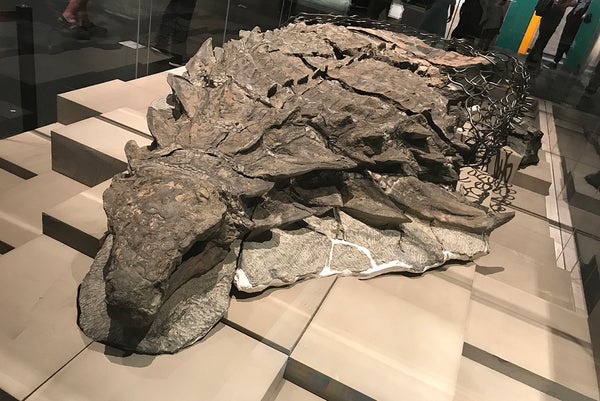
The thick body armour on some dinosaurs seems perfectly engineered to foil hungry predators. But the remains of a newly discovered armoured dinosaur hint that its spiky suit had another role: showing off to potential mates and rivals.
The spikes on a well-preserved fossil of a 1,300-kilogram armoured dinosaur called Borealopelta markmitchelli exhibit the same growth pattern as antelope horns and other structures used for both defence and display, says vertebrate palaentologist Caleb Brown of the Royal Tyrrell Museum of Palaeontology in Drumheller, Canada. “They might have been billboards, basically, to advertise for the animal,” Brown says. He is scheduled to present his findings on August 26 at the Society of Vertebrate Paleontology annual meeting in Calgary, Canada.1
Fossils generally don’t reveal much about the size of a dinosaur’s spines when it was alive. Armoured dinosaurs were sheathed in bone plates, but that bone was also crowned by more flexible tissue made partly of keratin. Such soft tissue is seldom preserved in the fossil record, leaving researchers uncertain of the size and variety of these keratin caps.
On supporting science journalism
If you're enjoying this article, consider supporting our award-winning journalism by subscribing. By purchasing a subscription you are helping to ensure the future of impactful stories about the discoveries and ideas shaping our world today.
But researchers got a rare glimpse of this soft tissue with the 2011 discovery in Canada of the first specimen of B. markmitchelli, which lived 110 million years ago. The exquisitely preserved fossil allowed Brown to measure both the keratin caps and bone plates from the animal’s snout to its hips. He found that the flatter bone plates closer to its tail were covered with a thin crust of keratin. But the keratin on the tusk-like spines protruding from the animal’s shoulders was much thicker, making up one-third of the spines’ length. Chunky keratin ornaments also capped the bone spikes on the animal’s neck.
Up and down the animal’s body, the taller the bone plate, the thicker its cap of keratin. Brown says that pattern is common in horns and antlers, which today’s animals use to send signals to each other as well as to fend off attackers.
Armour attraction
It’s also telling that B. markmitchelli’s most elaborate decorations are near the front of its body, as are modern-day horns and antlers. Two Borealopeltas facing off would each have gotten an eyeful of bristling armour.
The details add up to suggest that the evolution of B. markmitchelli’s flashy spikes was driven by the demands of social communication. The adornments might have provided a warning to potential foes, a lure to potential sexual partners —or both.
The argument that dinosaur armour had a role beyond protection makes sense, says vertebrate palaeontologist Thomas Holtz of the University of Maryland in College Park. “This is a nice indication that there is more to armour than absorbing damage,” he says.
B. markmitchelli tells scientists “an incredible amount”, agrees vertebrate palaeontologist Michael Burns of Jacksonville State University in Alabama. The animal helps to reveal how armour was patterned and how it evolved over time, he says, but saying that the spikes served a role in mating displays is speculation, given that there’s data from only one specimen.
Brown agrees that his idea isn’t definitive. Other exceptionally preserved fossils would help to confirm his thinking, he says, although it may be a long time before researchers are lucky enough to find anything to match Borealopelta.
This article is reproduced with permission and was first published on August 26, 2017.