
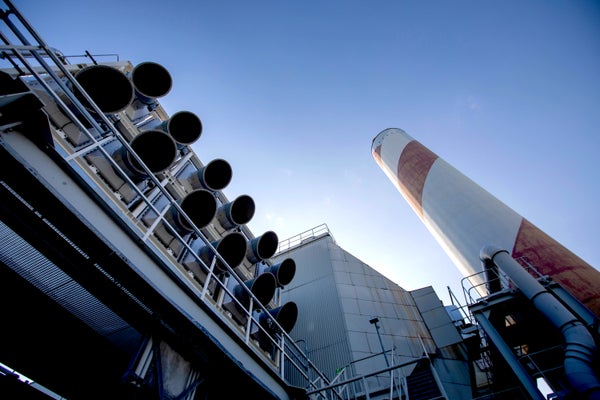
The online retail platform Shopify, Canada’s most valuable company, yesterday inked a deal to suck out of the atmosphere 10,000 metric tons of carbon dioxide and store it permanently underground.
Shopify Inc.’s agreement is the largest publicly announced corporate purchase of direct air capture, or DAC, for carbon offsets, according to Carbon Engineering, a Canadian firm seeking to commercialize the nascent climate-change-fighting technology.
Carbon Engineering promised Shopify it would store the e-commerce company’s carbon offsets—roughly equivalent to the emissions from 132 tanker trucks’ worth of gasoline—in a DAC facility it expects to bring online in 2024.
On supporting science journalism
If you're enjoying this article, consider supporting our award-winning journalism by subscribing. By purchasing a subscription you are helping to ensure the future of impactful stories about the discoveries and ideas shaping our world today.
“Large-scale DAC-based carbon removal is essential to undo 200 years of burning fossil fuels,” said Stacy Kauk, the director of Shopify’s Sustainability Fund, in a press release. “We need others to join us with purchase commitments so we can kickstart the market, scale this technology globally, and start reversing climate change.”
Shopify, which is worth about $140 billion, is the first company to use Carbon Engineering’s new DAC service. The offsets company said yesterday that it is now accepting DAC carbon offset purchases from other customers, including ones as small as 100 metric tons.
“We’re on the brink of large-scale deployment of our technology and the next critical step is accumulating market interest and securing customers,” said Carbon Engineering CEO Steve Oldham in a separate release. “This new service allows us to do that. It also makes it easy for companies and governments to include permanent carbon removal in their net-zero plans.”
Derik Broekhoff, a senior scientist at the Stockholm Environment Institute and an expert on carbon offsets, called Shopify’s DAC purchase “pretty close to bulletproof” from an environmental perspective.
“If companies are looking for high-value mitigation investments that drive the development of long-term climate solutions (and they should), this is the type of thing they should invest in,” he wrote in an email.
The financial terms of Shopify’s purchase were not disclosed. A spokesperson for the online retail platform said the amount of the contract and cost per ton offset were “confidential information at this time.”
In a September 2019 letter, Shopify CEO Tobias Lütke committed the company to spending at least $5 million annually on environmental initiatives via its sustainability fund.
That pledge included $1 million each year for sequestering carbon. Lütke estimated the cost of sequestering carbon dioxide via DAC at the time was upward of $1,000 per metric ton.
Last October, Shopify made its first multiyear DAC investment, purchasing 5,000 metric tons from Climeworks, a DAC company based in Zurich. Climeworks is planning to start operating a plant in Iceland later this year that will be capable of capturing 4,000 tons annually.
The Shopify spokesperson said 23% of the company’s sustainability fund in 2020 went toward DAC and confirmed that the Carbon Engineering deal will count toward this year’s efforts.
Shopify’s latest sustainability report shows the company has purchased enough carbon offsets over the years to offset all the emissions associated with its operations and energy use dating back to its 2004 founding. Its platform also runs on the renewable energy-powered Google Cloud.
Despite those efforts, Shopify’s carbon footprint continues to grow. Its buildings and work travel produced roughly 7,960 metric tons of carbon emissions in 2019, the most recent year for which data is available, an increase of nearly 9% from 2018 levels.
In a footnote of its sustainability report, Shopify said the jump was “likely due to a 25% increase in our number of employees, a 7% increase in our office square footage, and other external factors.”
Shopify’s spokesperson emphasized that the emissions intensity of the company’s operations is decreasing and argued its early support for DAC could be a climate game changer.
“The scientific consensus is that we need to reduce emissions, while also developing technologies and solutions to remove legacy emissions from the atmosphere,” the spokesperson said in a statement. “Emissions reductions will only get us so far, and solutions like DAC paired with standalone sequestration will be needed to bring the concentration of carbon dioxide back down to pre-industrial levels.”
While Broekhoff applauded Shopify for its efforts to advance DAC commercialization, he suggested the company should prioritize cutting the amount of carbon it releases into the atmosphere.
“Even ‘bulletproof’ offsets like these should only be used as part of larger corporate strategies to reduce value-chain emissions and advocate for strong climate policy generally,” he wrote.
Reprinted from E&E News with permission from POLITICO, LLC. Copyright 2021. E&E News provides essential news for energy and environment professionals.