

On topics ranging from astrophysics to public health, rejections of scientific consensus can prove quite inflexible when bolstered by religious doctrine. But a new approach to teaching evolutionary biology appears to ease such tensions. It involves airing perceived conflicts between religion and evolution in the classroom rather than simply presenting a mountain of evidence for evolution. Such a curriculum could help biologists (most of whom claim to hold no religious beliefs) more effectively prepare students (most of whom profess belief in God) to meet the nation’s growing need for scientists and technologists.
During a two-week module on evolution that was part of an introductory biology course at Arizona State University, the instructor explored a variety of viewpoints about the relation between some religious beliefs and the development and diversification of life, ranging from evolution without the involvement of a deity to various types of creationism—including theistic evolution. Students were encouraged to express their opinions and concerns.
Surveys filled out by 60 students before and after the module revealed that the number of students who perceived a sense of a conflict between religion and evolution at the start was cut in half by the end. An analysis of the results is detailed in the February issue of the American Biology Teacher.
On supporting science journalism
If you're enjoying this article, consider supporting our award-winning journalism by subscribing. By purchasing a subscription you are helping to ensure the future of impactful stories about the discoveries and ideas shaping our world today.
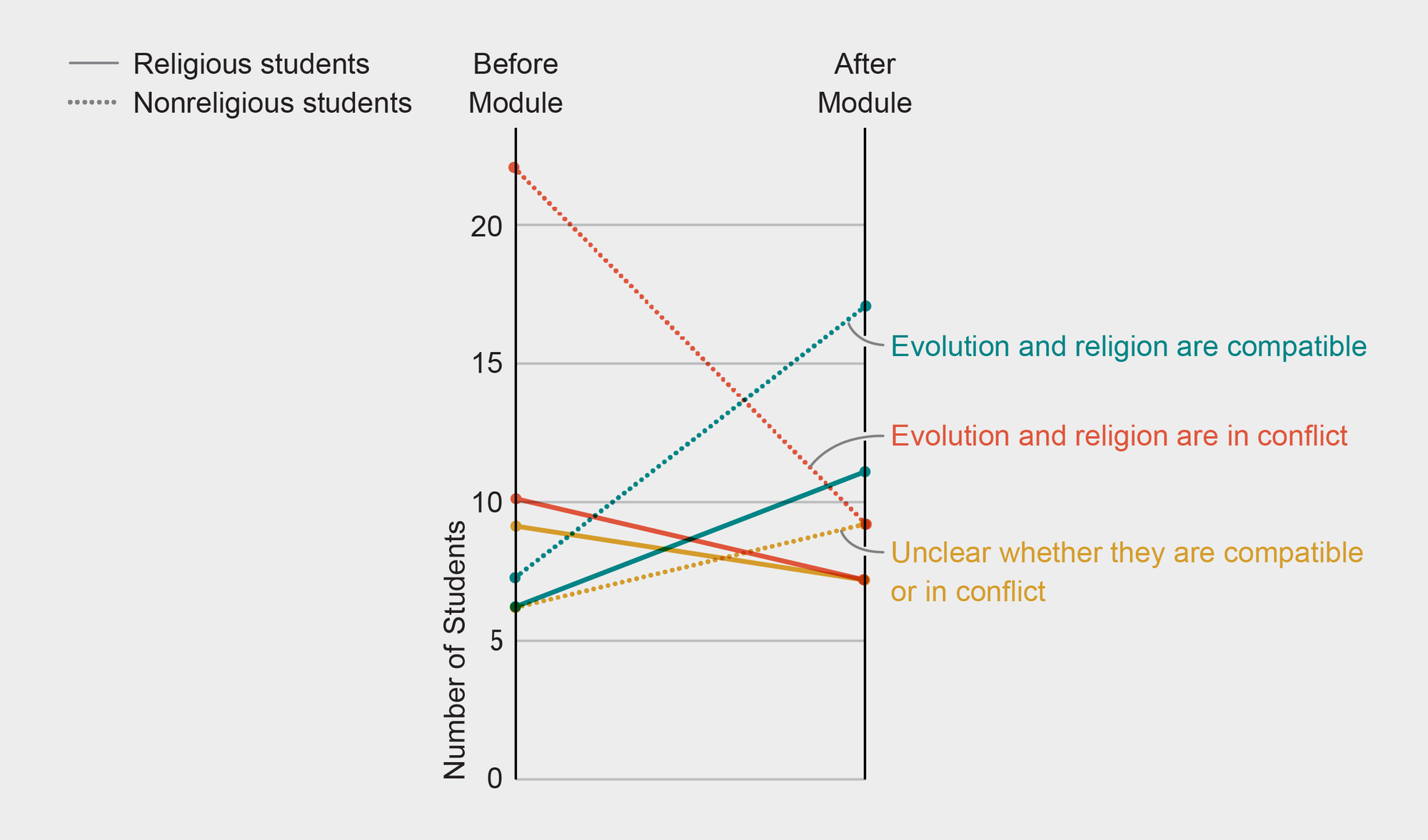
Graphic by Amanda Montañez; Source: “Impact of a Short Evolution Module on Students' Perceived Conflict Between Religion and Evolution,” by M. Elizabeth Barnes et al., in American Biology Teacher, Vol. 79, No. 2; February 2017
In response to instructors’ concerns about limited classroom time, a follow-up project compressed the two-week module to six minutes. Remarkably, unpublished results suggest this brief exposure also proved effective at reducing students’ perception of a conflict. “If we encourage national policy documents that promote these teaching practices,” says study co-author Elizabeth Barnes of Arizona State, “perhaps we can increase acceptance of evolution among our students, future teachers and future political leaders.”