
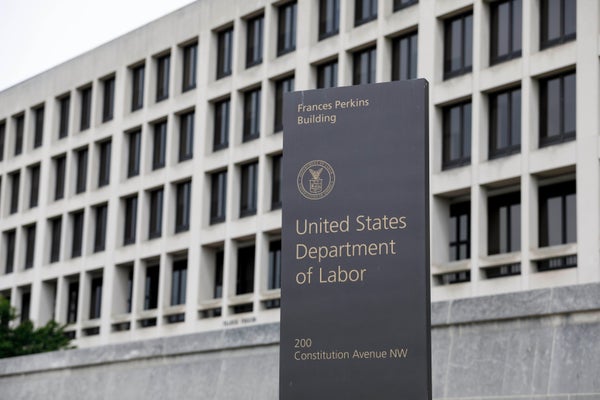
CLIMATEWIRE | A number of safety documents containing the word "diversity" were removed from the Department of Labor website. But they weren't the kind of racial and gender diversity programs that the Department of Government Efficiency has been targeting.
Instead, they dealt with the diverse size and shape of firefighters — a detail that helps them properly fit into safety equipment like ventilator masks. Another document that was taken down pointed to the diverse set of situations that first responders might be working in.
Their removal was prompted by President Donald Trump’s executive order to end federal diversity, equity, inclusion and accessibility initiatives, as well as White House missives to stop promoting "gender ideology."
On supporting science journalism
If you're enjoying this article, consider supporting our award-winning journalism by subscribing. By purchasing a subscription you are helping to ensure the future of impactful stories about the discoveries and ideas shaping our world today.
The Trump administration has been searching for those terms in programs, grants and documents to trigger funding freezes and to shutter initiatives aimed at counteracting discrimination based on people's race, gender and disabilities.
Larges swaths of government webpages have been taken offline in the past month as a result. That includes a 2015 guide from the Occupational Safety and Health Administration, an arm of the Labor Department, about restroom access for transgender workers. The removed document cited OSHA’s sanitation standard requiring employers to provide workers with toilet facilities.
Accessed via the Internet Archive, the 2015 guide notes that OSHA has long interpreted that standard to mean that “employers may not impose unreasonable restrictions on employee use of toilet facilities.” It also explains that “bathroom restrictions can result in employees avoiding using restrooms entirely while at work, which can lead to potentially serious physical injury or illness.”
Other documents that were removed include guidance for first responders when they treat and transport victims of chemical releases and guidance for small businesses about what personal protective equipment, such as respirators, they should use in diverse scenarios.
OSHA did not respond to requests for comment. But emails obtained by the website Popular Information show OSHA public affairs officials announcing to agency staff that the publications were removed from the website and will not be distributed from OSHA’s warehouse. The Feb. 7 email said, “if you have wallet cards that include language, or can be interpreted, on DEIA or gender ideology, please dispose of them as well.”
The purge has caught the attention of lawmakers. House Democrats on the Education and Workforce Committee wrote a letter to Vince Micone, acting secretary of Labor, to raise their concerns last week.
“If erasing these documents relates to President Trump’s executive orders on so-called ‘gender ideology’ and ‘diversity, equity and inclusion,’ DOL appears to be implementing the orders as though there is a list of banned words, without any regard for the context in which the words are used,” they wrote.
The removed guidance about treating victims of chemical exposures describes first responders as a “diverse group,” referencing not race and ethnicity but “the diverse conditions under which EMS responders could work,” such as full time, part time or as volunteers. “Their risks vary with their primary and secondary roles,” said the guidance, which is accessible only via the Internet Archive.
Other removed documents provided guidance for properly fitting respirators for health care professionals. It mentions gender only to note that protocol for testing the masks has a “built-in capability to [adapt for] unique work rate, mask and gender situations that might apply in a specific workplace.”
That document is among a few that have been reposted to OSHA’s website this week after House Democrats raised concerns.
But other documents — including those about first responders and workplace violence in health care settings — remained offline as of Thursday afternoon.
Reprinted from E&E News with permission from POLITICO, LLC. Copyright 2025. E&E News provides essential news for energy and environment professionals.