
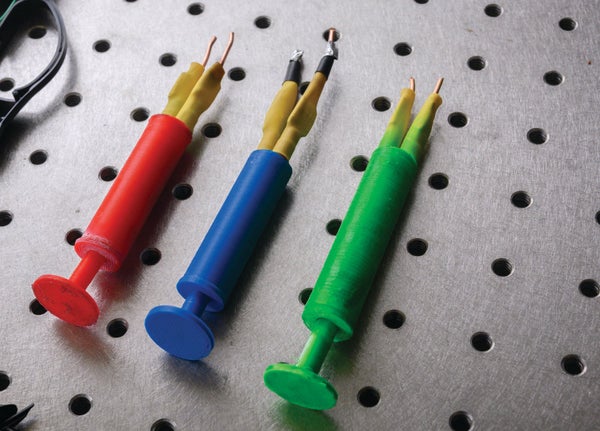
A new DIY machine for opening pores in cells relies on repurposed parts from a common lighter. Called the ElectroPen, it joins a tradition of “frugal science” that aims to equip students and field researchers with low-cost versions of pricey instruments.
“The future is synthetic biology: not just coding in a computer, but really coding living cells such that they help us with grand challenges of disease, of climate change, of environmental pollution,” says ElectroPen co-creator Saad Bhamla, a bioengineer at the Georgia Institute of Technology. But editing a cell's genome requires more equipment than modifying computer code does. So Bhamla worked with a local high school science class for about two years to develop cheap versions of several necessary tools—including one called an electroporator.
For tasks such as testing drug reactions or modifying DNA, scientists must first breach protective cell walls. An electroporator forces these membranes open with a brief, high-power burst of electricity. “Electroporation is basically a way to create pores in different cells that allow you to then introduce nucleic acid, for example, [or] protein inside the cells,” says Xavier de Mollerat du Jeu, director of product development at biotechnology company Thermo Fisher Scientific, who was not involved in developing the tool. Typical electroporators, which cost thousands of dollars, use electronic circuits to produce tailored shocks. But there is a cheaper method: piezoelectric crystals, which release an electric charge when they undergo mechanical stress. Bhamla's group published an open-source guide to making an electroporator from a piezoelectric butane lighter in January in PLOS Biology.
On supporting science journalism
If you're enjoying this article, consider supporting our award-winning journalism by subscribing. By purchasing a subscription you are helping to ensure the future of impactful stories about the discoveries and ideas shaping our world today.
“Creative solutions are almost lurking under our noses,” says Manu Prakash, a bioengineer at Stanford University, who once supervised Bhamla but was not involved in the new study. “All of us have used a spark lighter before, and one of the things I find beautiful is it's used [for] a very different purpose.”
The ElectroPen produces a five-millisecond burst of 2,000 volts, whereas a commercial machine can be tuned to different durations and voltages for various applications. But the ElectroPen is much more accessible: anyone can build their own for a few dollars to crack at least one cell type. “There is definitely a need for low-cost entry to be able to have everyone do those experiments,” du Jeu says. “It's good to democratize it.” So far high school students have used an ElectroPen to modify Escherichia coli DNA so it produces fluorescent proteins.
Meanwhile Bhamla is already planning his next frugal science project. Making cheap instruments, he says, is “like providing a phone—you leave it to other people to think about what app they want to make on it, what cell they want to modify, what challenge they want to go after.”