
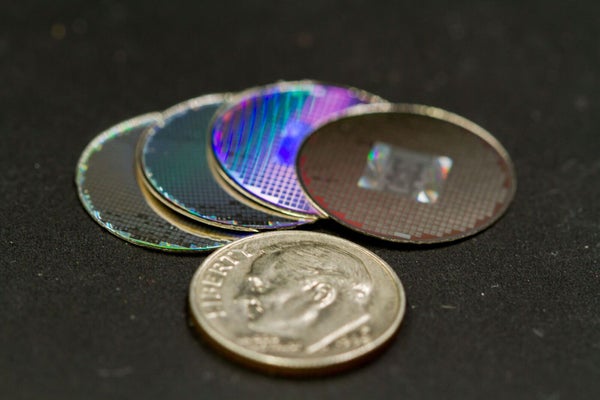
If humans are wiped out by an asteroid—or our own folly—what will be left of us? Our data, at least, if the Arch Mission Foundation’s plans play out. The Los Angeles–based nonprofit organization says it will launch the texts of 20 “important books” chosen by Project Gutenberg (a volunteer effort to digitize printed material), as well as 10,000 crowdsourced images, to the moon in 2020 to begin its Lunar Library. Project organizers hope eventually to include all of Wikipedia, as well as genome maps and much of the world’s greatest art, music, literature and scientific knowledge.
To record such a mind-boggling amount of information, the foundation is turning to a novel form of data storage: DNA. New technologies use the four base nucleotides, or “letters,” of the genetic molecule—adenine, thymine, guanine and cytosine—as digital bits to encode data, similar to how computers convert information into binary zeroes and ones. The foundation aims to make the Lunar Library’s initial installment the largest collection of data ever written in synthetic DNA.
The first stage of the Lunar Library is due to launch in 2020 aboard an Atlas V rocket and be delivered to the lunar surface by a robotic lander called Peregrine, made by the private space start-up Astrobotic. The trip will be Peregrine’s first mission, and Arch Mission Foundation’s books and images, in their digital DNA form (encased in layers of metal shielding within a small container), will be among its first payloads.
On supporting science journalism
If you're enjoying this article, consider supporting our award-winning journalism by subscribing. By purchasing a subscription you are helping to ensure the future of impactful stories about the discoveries and ideas shaping our world today.
Scientific American recently spoke with Arch Mission Foundation co-founder Nova Spivack about the practicality of his plans, the intended audience and the benefits of DNA storage.
[An edited transcript of the interview follows].
What is your big-picture goal for the Lunar Library?
We formed the Arch Mission Foundation after many years of research into the question of how to preserve human civilization over geological timescales—millions or billions of years. When you look at the history of civilizations on Earth, it turns out most of them don’t make it, statistically. There could be a solar flare, some kind of impact from an object we didn’t know was there. With all of these threats it seems prudent to develop an insurance policy for backing up our data. Our plan is to land a giant library on the moon. It will be there forever, literally. We’re trying to transmit the largest message that we can through the longest amount of time.
Why did you decide to use DNA to store your data?
We discovered that there really are no modern media that can do it. Solid-state drives and optical disks have a lifetime that’s measured in decades. Not only do the actual physical materials degrade, but the hardware for accessing the data also has a short lifetime. Our constraints are unique. We need to store petabytes [a petabyte is a million gigabytes]. Using DNA as a building block you can write and store information in an extremely small volume. A tiny liquid droplet could contain Amazon’s entire data center. You can then replicate it inexpensively to create literally billions of copies.
We’re using synthetic DNA. It doesn’t code for a living organism—it’s just data storage. We take the DNA, as a liquid or powder, and encapsulate it into a special material that can then be further encapsulated into a film about the thickness of paper. We’re “writing” 20 famous books plus 10,000 images. We believe this is the largest library written into DNA of its kind.
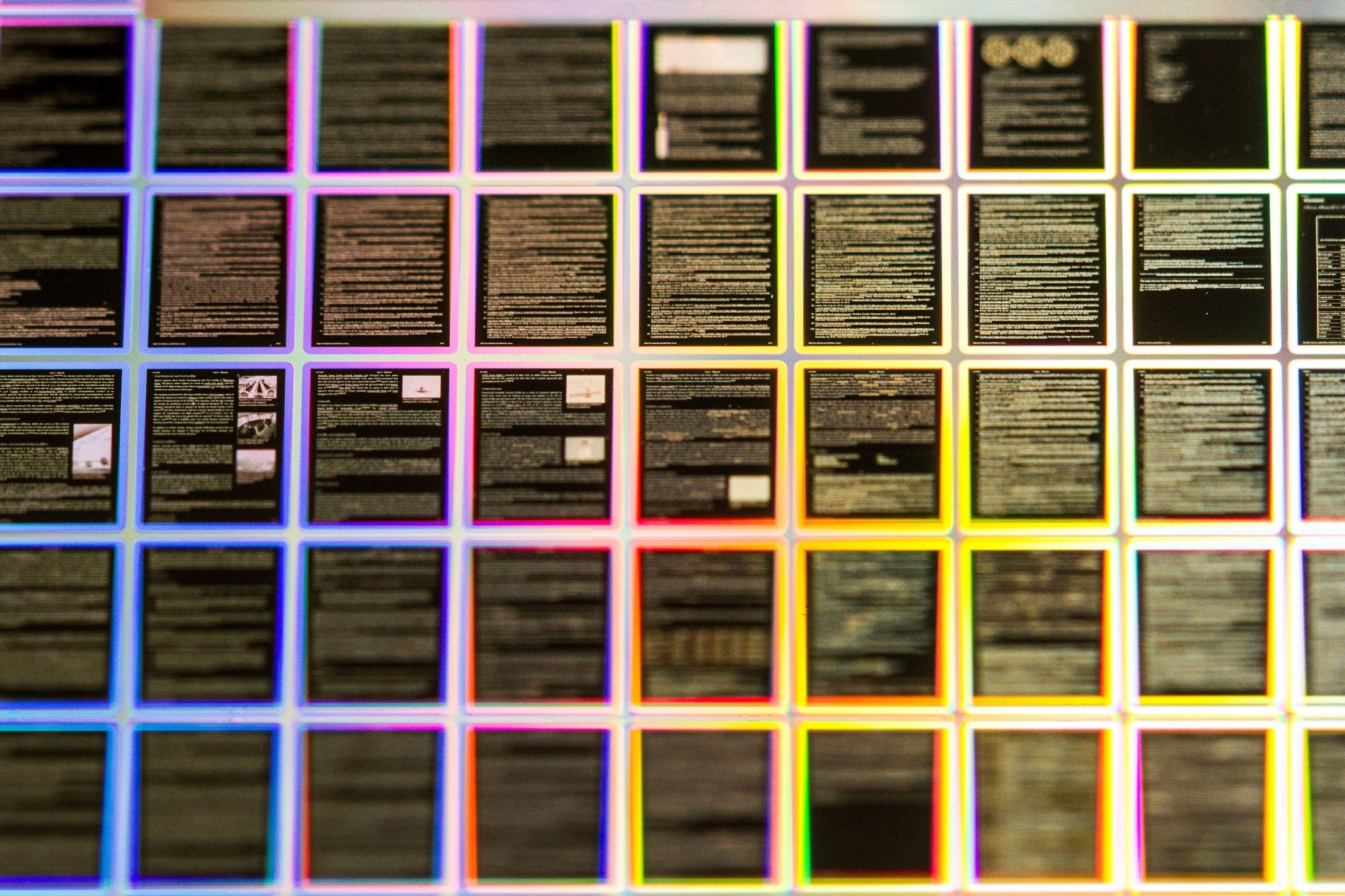
The laser-etched images of the primer layer of information in the Lunar Library will be visible with powerful microscopes, included in the library. Credit: Bruce Ha and provided courtesy of The Arch Mission Foundation
DNA can be fragile and prone to errors. Why is this a good option for long-term storage?
A lot of the errors in DNA happen when you reproduce it using sexual selection. In this case we don’t have that problem. When we replicate it, we’re making fairly exact copies. The fragility of DNA molecules is a challenge, but they are actually quite stable and durable on Earth in a controlled environment. They don’t degrade over millions of years—we’ve found DNA preserved in amber from the dinosaurs.
We have to do some experiments to test how well it will fare in the space environment and in the environment of the moon. There are extreme temperatures, and you have cosmic rays. But the key with DNA is many copies in many locations. What if the moon blows up? We have to put it in other locations around the Earth and many other solar system locations. We can statistically guarantee that this data set will be there if there’s anybody to find it in several billion years.
Even if this data set does manage to survive for billions of years, what are the chances that whoever finds it can read it?
We have to make a few assumptions. It must be a lifeform that’s at least as intelligent as we are and that has eyes and can see in the visible spectrum. If it’s a microbial civilization that’s so small that these things look like planets to them, that’s obviously not going to work.
We start with a primer layer, which is millions of images, that teaches [whoever finds the library] what they need to know to assemble the computers and other devices to read the deeper layers of data. The primer layer is visual data, etched on nickel or quartz at about 300,000 dots per inch by special laser technology. You don’t need a computer to see it and the images are not digital—you can see these through a relatively low-power microscope (we provide the microscope, of course). From there we teach what you need to know to understand that data. And then we teach what you need to know to extract and understand the much larger digital data.
When the Voyager probes launched their famous “golden records” [of sounds and images] in the 1970s, they were meant as art projects as much as a practical message that aliens would be likely to read. Do you consider your library primarily functional, or symbolic?
There is an aspect of this that’s a grand gesture that brings together our hopes and dreams about becoming a spacefaring civilization. Like all great monuments, it’s a cultural and symbolic gesture. But we are also trying as well as we possibly can to make this something that can be used in the future. Under the assumptions we’ve made, I actually think it’s reasonable to believe [future life-forms] will be able to understand this.
The benefit of this is also not only for hypothetical potential beings in a million years. It’s also now. We’re like a privately funded DARPA specifically focused on preservation and the technologies that enable that. We are spurring research that is yielding potential benefits today.