
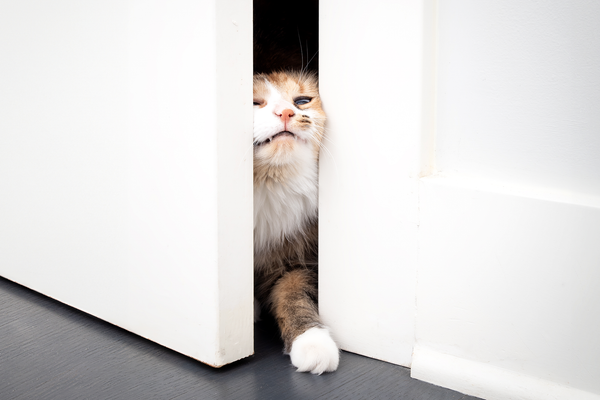
If your cat seems to hate closed doors, follows you to the bathroom and meows for attention constantly, you are not alone—these attention-seeking behaviors are quite common. And to us humans, that apparent need to be near the action can feel very familiar. We’ve even given that anxiety a name: FOMO, or the fear of missing out.
Many onlinecommentators have described their cat’s compulsions to join them in the shower or sit on their laptop keyboard as an expression of FOMO. But is FOMO really why cats (seemingly) demand human attention? Not exactly, according to feline behavior experts, who say that there are many better ways to explain these behaviors.
Take cats’ apparent disdain for closed doors, for example: that may come from a need to be aware of their environment, says Karen Becker, a companion animal veterinarian based in Illinois. Cats are curious, territorial animals that are both predator and prey; to avoid getting eaten, “cats are highly sensitized to making sure that they are safe in their environment,” Becker explains. When there is an obstacle in the form of a closed door, cats develop the urge to know what’s on the other side—whether that’s a predator to hide from or prey to ambush.
On supporting science journalism
If you're enjoying this article, consider supporting our award-winning journalism by subscribing. By purchasing a subscription you are helping to ensure the future of impactful stories about the discoveries and ideas shaping our world today.
So when someone enters a room and shuts the door, our feline friends do indeed get frustrated about not being able to know what is happening inside the room, says Carlo Siracusa, who researches clinical behavior medicine at the University of Pennsylvania School of Veterinary Medicine. But that doesn’t mean cats feel left out and get the urge to know what humans, specifically, are doing in the room. Cats are generally curious about movements in their environment, and most activity in an apartment or house involves humans, Siracusa says. “This is another reason why cats want to be around us when we do something,” he adds.
Sheer boredom, then, may be the source of many attention-seeking behaviors such as meowing, scratching and pawing, Becker says. Though cats are generally well cared for in North America and other areas, she says, “it’s heartbreaking as a practitioner to see a vast majority of cats feeling so bored.” These FOMO-like behaviors are cats’ cries for substantially more environmental enrichment, according to Becker.
Many people who acquire cats as pets think the animals are simple and easy to care for, she adds. “But the truth is many cats get bored—so much so that they tend to sleep in excess because they have nothing else to do.” Feline bodies are wired to move regularly in short bursts of energy, Becker elaborates. That’s one reason why the animals like to chase flies and other insects. She recommends that cat owners carve out five to 10 minutes once or twice a day to exclusively spend time with their pets, which may make the animals express different play behaviors and new ways of interaction. Also, if possible, cat owners can provide safe indoor and outdoor sensory experiences that satisfy cats’ unique needs, including being able to scratch and climb. Cat owners can also enhance their pets’ environmental enrichment as they feed them—for instance, with food puzzles that the animals must play with to extract their dinner.
Although cats like to interact with humans—studies have shown that they form strong attachments to their caregivers—it doesn’t mean that they like to stay close to humans at all times, Siracusa says. Humans sometimes overestimate how much cats are willing to spend time with them. A cat may jump up on the couch and sit on your lap just to stay warm, not because it’s looking for your undivided attention. In fact, petting a cat excessively could sometimes lead to aggressive behaviors such as biting and scratching, he says.
And in general, cats are also more cautious creatures than the FOMO theory tends to give them credit for. They don’t tend to run pell-mell into a situation where action is happening because they like to be aware of threats to take control of their domain, says Jane Ehrlich, a feline behaviorist based in Arizona. “We see everything through [a] human lens,” she says, but we “need to start thinking from cats’ point of view.” Indeed, a recent survey showed that the more we humans anthropomorphize our cats, the less we correctly understand their emotional cues.
Becker agrees that we need to be very cautious of translating human emotions to animals. “Our job is not to try and make them more human,” she says. “Our job is to be more supportive of their natural behaviors and cater to their needs.”