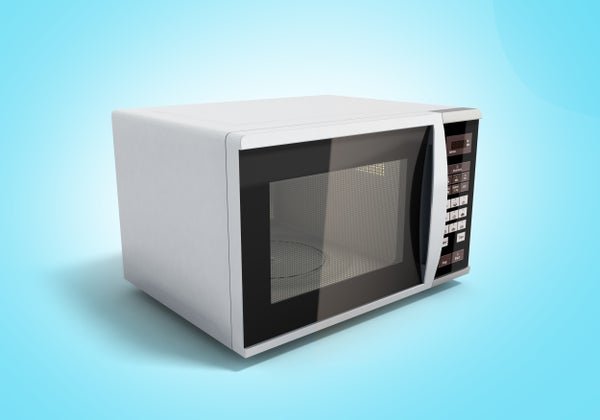
In 1946, an engineer was working near a piece of equipment known as a magnetron which is part of a radar system when he noticed that the radar emission at microwave frequencies melted the snack bar he had stashed in his pocket. Legends disagree as to whether it was a peanut cluster bar or a chocolate one, but the fact remains that rather than just mourning the loss of his snack, he did a little investigating.
He and his coworkers realized that focused beams of microwave emission—that’s waves of energy at frequencies near the radio frequency regime—will cause polar or electrically asymmetric molecules like water in food to rotate. This rotation produces thermal energy (aka heat) which then can quickly and nearly uniformly heat the food.
On supporting science journalism
If you're enjoying this article, consider supporting our award-winning journalism by subscribing. By purchasing a subscription you are helping to ensure the future of impactful stories about the discoveries and ideas shaping our world today.
The microwave was born and dinnertime around the world saw a revolution. The first thing those engineers tried to cook was popcorn. The second thing was an egg which, of course, exploded in their faces.
Now, according to the U.S. Census Bureau, 97% of households in the United States have a microwave. But how much does the average household understand how a microwave works? What misconceptions about our microwave use persist? Let’s take a look at four microwave myths that science has proven false.
Great science journalism requires human expertise, time, effort and creativity. And it costs money. That’s why I and the journalists here at Scientific American hope you’ll join our community.
When you subscribe, you are supporting staff and freelance journalists who are passionate about telling science stories that are true, important and compelling. Our editors and reporters are often experts in their fields, which means they understand the nuances of big discoveries and can untangle the breakthroughs from the hype. With a subscription, you are also supporting rigorous fact-checking to ensure the words we publish are precise and accurate. And you’re supporting original illustrations, graphics and photos that bring you closer to an advanced laboratory, an ice sheet in Antarctica or a space mission in orbit. You’re helping us craft other types of high-quality journalism as well: Our newsletters are carefully written, edited and curated by staffers you have or will come to know and love. Our Science Quickly podcast is based on original reporting, collaboration with editors and scientists and exacting production.
Subscriptions keep this engine running so we can continue to deliver thoughtful, rigorous and independent science journalism to you. In an era of viral misinformation, this work is crucial. If you value what we do, I hope you’ll consider joining us as a subscriber
Thank you,
Jeanna Bryner, Editor in Chief, Scientific American