
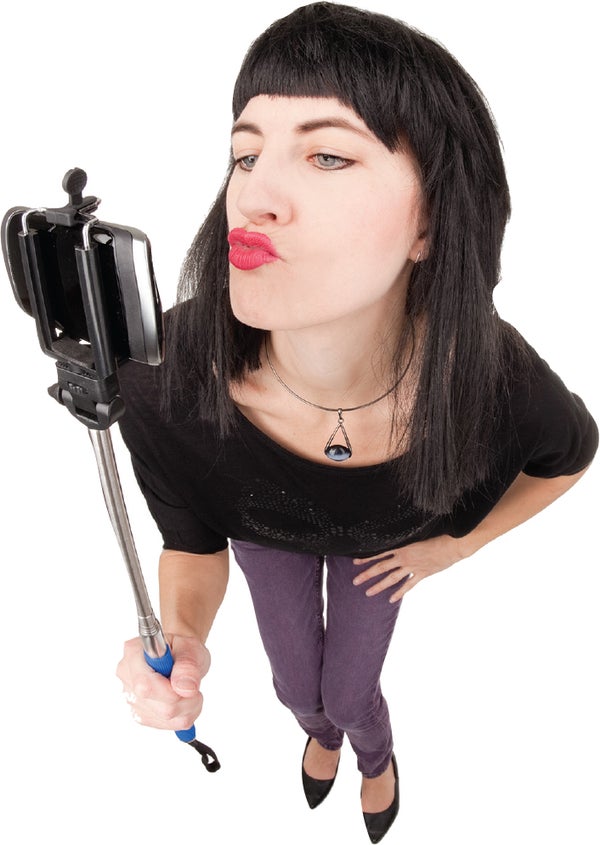
People regularly see themselves as more attractive and talented than others see them. Now the rise of selfies has deepened the hue of this rose-tinted mirror. According to new research, people who take frequent self-portraits think these pics put them in the best light, even when others see selfies as, frankly, unflattering.
For this study, published online in April in Social Psychological and Personality Science, college students were asked to take a selfie in the laboratory, and a researcher took a nearly identical picture of them. Then the students and a group of online participants of all ages rated the images.
The researchers found that people who regularly take selfies thought that they looked more attractive and likable in their selfies than in the photographs taken by an experimenter. Other observers, however, rated them as less likable and more narcissistic in their selfies as compared with the nonselfies. For students who do not usually take selfies, it was a triple whammy: in addition to being seen as less likable and more narcissistic, their selfies were also judged to be less attractive.
On supporting science journalism
If you're enjoying this article, consider supporting our award-winning journalism by subscribing. By purchasing a subscription you are helping to ensure the future of impactful stories about the discoveries and ideas shaping our world today.
People who do not regularly take selfies did not have the same bias about their own snaps as did regular selfie takers, perhaps because the selfie-indulgent have internalized positive feedback for their shots on social media, the researchers theorize. They suggest that selfie takers may also enjoy knowing they were the photographer because they have positive illusions about their photography skills, too.
“Exercise some caution when posting a selfie,” says Daniel Re, a researcher at the University of Toronto and the paper's primary author. “It might not be perceived the way you intend.”