
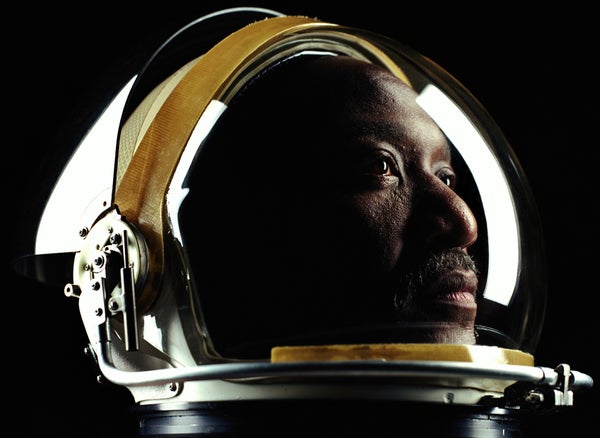

As of December 4, 2019, 565 people from 41 countries have gone into space. That’s it. 565 out of more than 7 billion of us currently on this planet. And that's using the definition of space travel to include any flight over 62 miles or about 100 kilometers.
Many of these space travelers are, of course, NASA astronauts. That means they went through a rigorous application and training process. So, what exactly does it take to be an astronaut?
On supporting science journalism
If you're enjoying this article, consider supporting our award-winning journalism by subscribing. By purchasing a subscription you are helping to ensure the future of impactful stories about the discoveries and ideas shaping our world today.
Minimum requirements to be an astronaut
To be considered for the NASA astronaut program is you must be a U.S. citizen. Dual citizenship is okay.
Beyond that, NASA sets three bare minimum requirements for their astronaut application. First, applicants must have a bachelor’s degree in engineering, biological or physical science, computer science, or math. Second, you must have three years of related professional experience or 1,000 hours of piloting. That professional experience could be teaching or time spent pursuing an advanced degree. And third, you must be able to pass something called the NASA long-duration Astronaut physical.
As part of that physical, you will have to be able to demonstrate 20/20 vision, although using glasses or having had LASIK surgery to do that is okay.
Age requirements
It may surprise you to learn that there are no age requirements for being an astronaut. (Of course, you have to be old enough to have met the professional requirements and able to pass the physical.) The typical age range spans 26 to 46-years-old.
Astronaut John Glenn, who made history as the first American to orbit earth, returned to space at age 77 as a payload specialist on the space shuttle Discovery. Over the nine-day mission, he participated in research to test the effects of microgravity on the aging body.
Physical requirements
There is also no specific body type required to be an astronaut, but you do have to fit in the spacesuit—called the extravehicular mobility unit—that the astronauts wear to do spacewalks. This may sound obvious, but spacesuits have historically been designed for men. In the 1970s, NASA offered an extra-small and small version of the men’s suit, but those still didn’t account for different the body types many women have, like larger hips and narrower shoulders. And budget cuts in the 1990s meant they did away with those smaller sizes altogether.
In March of 2019, NASA scheduled what was to be the first all-female spacewalk, but the historical event had to be canceled because there were not enough spacesuits to fit both women at the same time. Finally, in October later that year, the first all-female spacewalk did take place, with astronauts Jessica Meir and Christina Koch. A woman has not yet walked on the Moon.
Myths about astronaut requirements
As a teenager, I was told that getting a tattoo would mean I could never be an astronaut. This is not at all true. In fact, some Apollo astronauts were given tattoos– small dots to show where defibrillator pads should be placed in case of a medical emergency. Perhaps whoever told me the myth about astronauts not being able to have tattoos was trying to discourage me from getting one. (Sorry! It didn't work.)
»Continue reading “Do You Have What It Takes to Be an Astronaut?” on QuickAndDirtyTips.com