
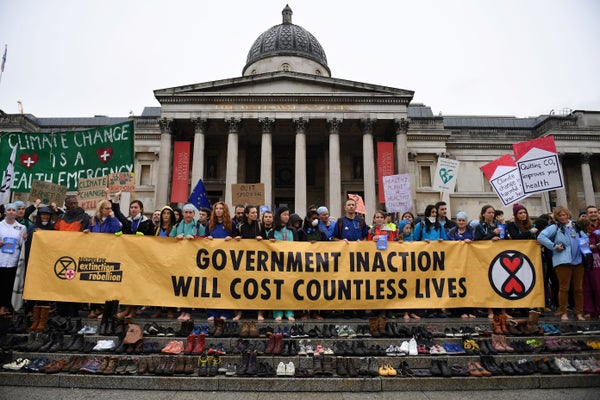
The editor-in-chief of one of the world’s oldest and most prestigious medical journals has said doctors and medical professionals should engage in nonviolent protests to address climate change.
Richard Horton of The Lancet said in a video uploaded by Rubber Republic last week that engaging in these social protests is part of the duty of a doctor. He said that the U.K.-based General Medical Council should be fully supportive of health professionals who engage in climate protests based on its own guidelines on the duties of a doctor.
“The climate crisis is one of the most, I would say the most, existential crisis facing our communities in the world today,” Horton said.
On supporting science journalism
If you're enjoying this article, consider supporting our award-winning journalism by subscribing. By purchasing a subscription you are helping to ensure the future of impactful stories about the discoveries and ideas shaping our world today.
His statement comes after multiple health organizations have taken action on climate change in the United Kingdom. Newcastle Hospitals declared a climate emergency in June, followed by the Royal College of General Practitioners in September. Other health organizations including the British Medical Association, the Royal College of Emergency Medicine and the Royal College of Physicians have committed to divesting from fossil fuels.
Health professionals have also joined the front lines of protests. In September, 30 doctors protested at the U.K. Department for Business, Energy and Industrial Strategy in London. Some of the protesters glued themselves to the building. Doctors for Extinction Rebellion, a climate-focused activist group, says four of its members were arrested.
More than 200 health professionals marched through London on Oct. 13 to protest government inaction on climate change, according to Doctors for Extinction Rebellion. The group says profound backing from medical professionals goes a long way to increasing support for the cause.
“This in turn will give the government a strong mandate to act as we feel it must, and empower those MPs who do take this seriously to take centre stage,” the group said on its website.
British Prime Minister Boris Johnson has previously dismissed Extinction Rebellion protesters as “uncooperative crusties” who should abandon their “hemp-smelling bivouacs,” according to multiple reports. But The Guardian reported that his father, Stanley Johnson, told protesters gathered in London that he wears the “uncooperative crusties” badge with pride.
“It’s one of the nicest things that has been said about me for a long time,” he is quoted as saying. “A non-cooperative crusty, absolutely superb—do they taste good?”
Horton wrote in an article posted to The Lancet on Oct. 5 that the United Kingdoms’s scientific community is doing too little to engage the public and politicians in the fight for climate justice. He wrote that unlike the science community, the health community is injecting moral force into the political debate about climate action.
Margaret Hamburg, chair of the board of directors of the American Association for the Advancement of Science, echoed his statement in a letter to scientists that same week, according to the medical journal.
“We must activate the science community to speak up in new ways to address the impacts of climate change at the local, state, national, and global level,” she said. “And we need to act now.”
Reprinted from Climatewire with permission from E&E News. E&E provides daily coverage of essential energy and environmental news atwww.eenews.net.