
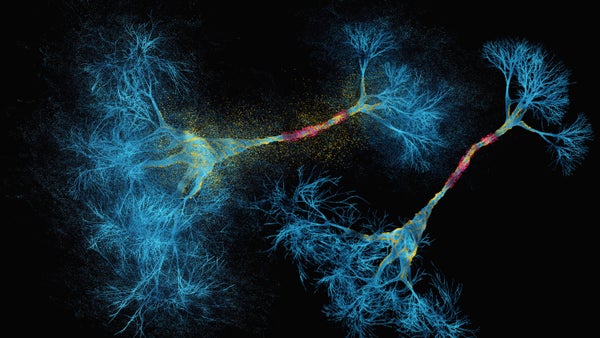
Does string theory—the controversial “theory of everything” from physics—tell us anything about consciousness and the human brain?
Outside of the theory itself being devised by conscious humans using their brains, there’s scant reason to think so. In a nutshell, string theory is a sprawling realm of theoretical physics that assumes that tiny vibrating strings are the fundamental basis of reality. If valid, it offers ways for unifying the quantum mechanics that govern the universe on small scales with the gravitational force that shapes the cosmos at larger scales. But the proposed strings are so unimaginably minuscule, and their associated math is so difficult and diverse, that the theory is widely considered to be experimentally unverifiable. Consciousness, meanwhile, is a notoriously slippery and ill-defined thing, but it generally seems to be an emergent property of biology, such as assemblages of neurons within our brains.
No meaningful overlap exists between these vastly disparate domains. Or does it? A new paper, published last week in Nature, posits that some of the arcane math of string theory actually helps explain the wiring of a brain’s neurons—as well as the branching of other “physical networks” such as tree limbs, blood vessels and anthills. “The work,” trumpets one institutional press release, “represents the first time string theory ... has successfully described real biological structures.”
On supporting science journalism
If you're enjoying this article, consider supporting our award-winning journalism by subscribing. By purchasing a subscription you are helping to ensure the future of impactful stories about the discoveries and ideas shaping our world today.
Senior author Albert-László Barabási, a distinguished professor and network scientist at Northeastern University, emphasizes that the paper isn’t claiming any profound, direct relationship between string theory and neuroscience. Rather it’s showing how mathematical techniques that have been developed in string theory can be used to better describe how physical networks organize themselves. But even so, using string theory’s math to understand neural wiring would be a surprisingly practical feat, given that the theory is so tenuously tethered to physical reality that skeptical physicists have called it “not even wrong.”
The potential linkage, Barabási says, springs from the fact that “physical networks are physically costly and thus try to optimize themselves,” even if we don’t yet know what exactly they optimize. The simplest approach would be a “wiring diagram” following the shortest routes between any two nodes to minimize length—but detailed three-dimensional scans and maps of physical networks have revealed more complex branching geometries and connections that show that some different optimization must be occurring. So instead Barabási and his team sought to explain how the structure of physical networks optimizes for minimal surface area rather than other factors such as length or volume.
“For many of these networks, like the vascular system that carries blood or the neurons that use ion channels to pump out neurotransmitters, you’re really talking about a tube, and the greatest cost is to build the surface,” he says. “But modeling surface minimization is a hell of a mathematical problem because you need to create locally smooth surfaces that patch into each other in a continuous way.”
Barabási’s former postdoc and the study’s first author Xiangyi Meng, now an assistant professor at Rensselaer Polytechnic Institute, realized that the seemingly intractable calculation was essentially identical to one for which string theorists had already developed sophisticated tools.
“While the mathematics of minimal surfaces has deep historical roots, our work relies on a specific advancement that classical geometry does not offer,” Meng says—namely a subtype of string theory called “covariant closed string field theory,” which was developed by Massachusetts Institute of Technology physicist Barton Zwiebach and others in the 1980s.
Covariant closed string field theory allows physicists to compute the smoothest, most efficient interactions—akin to minimal surfaces—between certain types of strings by treating them as vertices (corners) and edges; this approach is important for string-theory-based attempts to unify gravity and quantum mechanics. In the case of physical networks, Meng says, it offers a way to represent their growth as a series of sleevelike surfaces that are smoothly sewn together. “Crucially, classical minimization tends to collapse sleevelike surfaces into trivial wires,” he says. “Zwiebach’s formulation prevents this, maintaining a finite thickness for every link. This fundamental insight is what allows us to model the three-dimensional reality of physical networks, such as of neurons or veins, which must retain volume to function.”
The team then tested its approach against high-resolution 3D scans of physical networks, including those of neurons, blood vessels, tree branches and corals. In each case, they found that the string theory model produced a closer match than simpler classical predictions. In particular, the team’s model more accurately replicated the observed numbers and alignments of branches. “So what we were seeing is a behavior that’s not specific to the brain but universal across physical networks,” Barabási says. “It’s a very important step, I think, in understanding the mechanisms of how brains and other physical networks wire themselves and why they’re unusual.”
“This paper nicely shows that if you think [of physical networks] in terms of surface-area costs rather than wire length, things start to make more sense,” says Michael Winding, a systems neuroscientist at the Francis Crick Institute in England, who was not involved with the work. “That’s genuinely interesting. People usually think about surface area in terms of its effect on electrical properties—like how fast signals move within a neuron rather than as a construction cost to build a neuron.”
As for whether comprehending the wiring of the brain really demands techniques from the frontiers of theoretical physics, questions remain. Bona fide experts in both domains are few and far between. But one, Vijay Balasubramanian, a string theorist and brain-focused biophysicist at the University of Pennsylvania, is skeptical.
“I’m not sure that this study marks a critical breakthrough in our understanding of physical networks, and many experts may find the claimed relationship to string theory unconvincing,” he says. “So any assertion of revolutionary importance here seems premature. That said, this effort to apply physical principles to understanding biological networks makes a welcome addition to the scholarship in biophysics and neuroscience and will hopefully inspire further investigations.”