New Issue: Orbital Catastrophe Ahead? Read Now

Dog Genetics Reveal Surprising Relationships among Breeds

When it comes to dog traits, genetics-based lineages are more telling than human-made categories

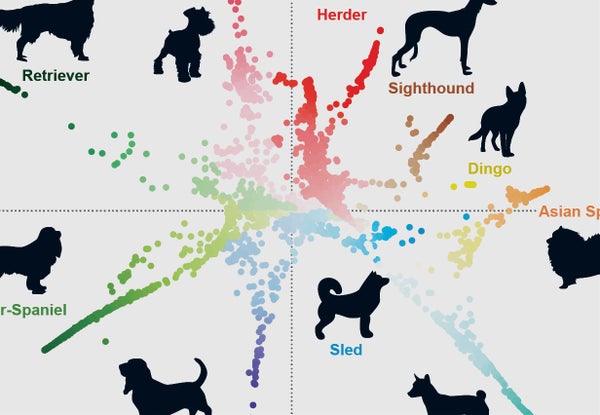
Detail of the main graphic, in which a scatterplot is punctuated with dog silhouettes and lineage names, including Herder, Sighthound and Dingo.

Emily V. Dutrow and MSJONESNYC

Join Our Community of Science Lovers!

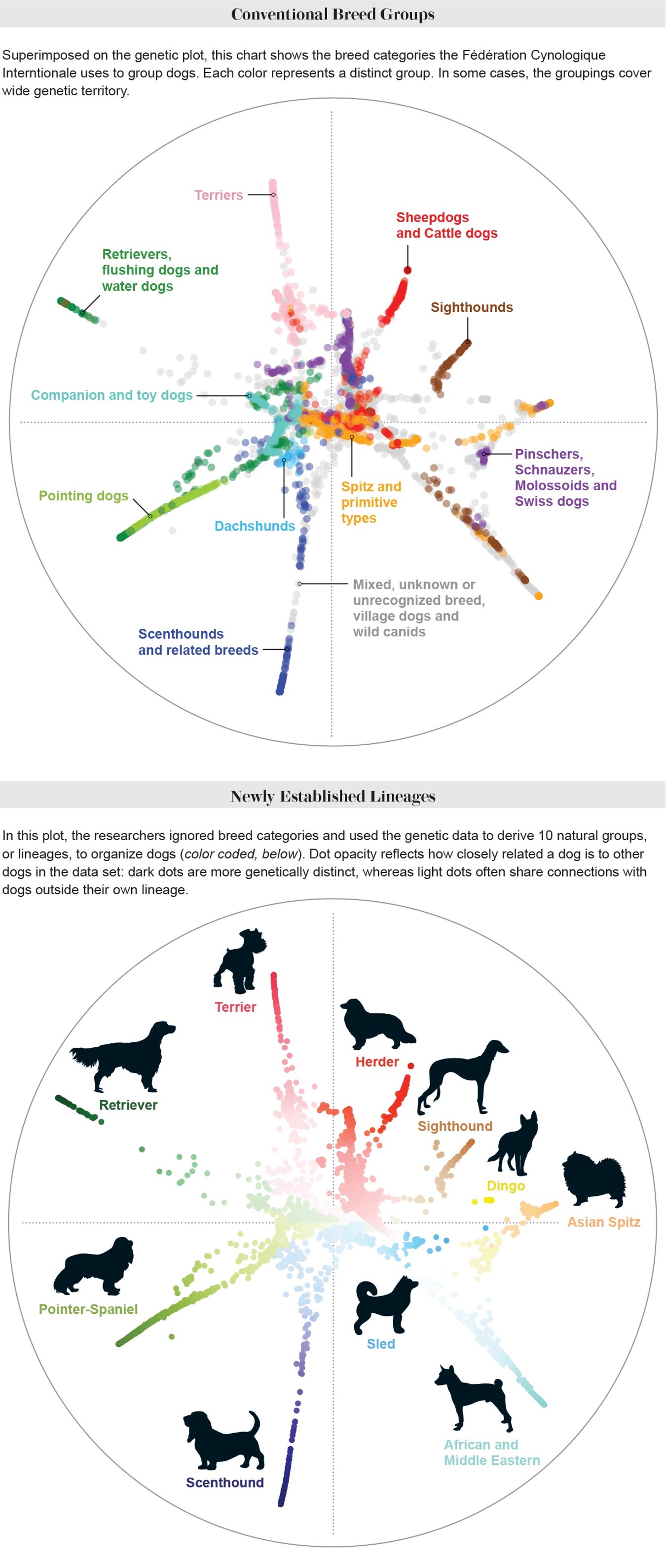
There are 356 unique breeds of dog, according to the Fédération Cynologique Internationale, the largest global organization of national kennel clubs. Yet understanding the genetic drivers for the behavioral traits that set these breeds apart has been a long-standing scientific challenge. In a recent study, scientists compiled DNA sequences for more than 4,000 domesticated and wild dogs to uncover the genetic connections between them and found that they sometimes defy the conventional, human-made breed categories. Instead of assuming that some breeds were related to others, the researchers found a new way to group dogs based on their genetics.

The analysis revealed that dogs fall into 10 “lineage” groups with close genetic connections. To see whether dogs in each lineage shared similar traits, the scientists combined their data with behavioral surveys filled out by the owners of around 46,000 purebred dogs. They found that many traits were common among members of each lineage and that certain genetic variants might be related to these traits. “We found a series of genes that turned out to be important in brain development in herding breeds,” says Elaine A. Ostrander of the National Human Genome Research Institute, a co-author on the study in Cell. “That's a great jumping-off point to study how herding dogs herd.”

These two plots show two different ways of categorizing dog breeds—one based on human-defined groupings and another based on “lineages” derived from genetic data. In both plots, each of the 4,000 dots represents an individual dog. Their positions (identical in both plots) reflect how closely genetically related they are to other dogs—two nearby dots are genetically similar, and two distant dots diverge more.


On supporting science journalism

If you're enjoying this article, consider supporting our award-winning journalism by subscribing. By purchasing a subscription you are helping to ensure the future of impactful stories about the discoveries and ideas shaping our world today.

Credit: Emily V. Dutrow and MSJONESNYC; Source: “Domestic Dog Lineages Reveal Genetic Drivers of Behavioral Diversification,” by Emily V. Dutrow, James A. Serpell and Elaine A. Ostrander, in Cell, Vol. 185; December 8, 2022 (reference)

Clara Moskowitz is chief of reporters at Scientific American, where she covers astronomy, space, physics and mathematics. She has been at Scientific American for more than a decade; previously she worked at Space.com. Moskowitz has reported live from rocket launches, space shuttle liftoffs and landings, suborbital spaceflight training, mountaintop observatories, and more. She has a bachelor’s degree in astronomy and physics from Wesleyan University and a graduate degree in science communication from the University of California, Santa Cruz.

More by Clara Moskowitz

Emily V. Dutrow is a geneticist interested in the evolution of complex traits. She is a postdoctoral fellow at the National Human Genome Research Institute of the National Institutes of Health where she studies canine behavioral diversification.

More by Emily V. Dutrow

MSJONESNYC (Heather Jones) is an award winning information and motion graphics designer based in Brooklyn. She enjoys exploring the world through graphics, using text, data, illustration, and motion. Her work can be found at msjonesnyc.com.

More by MSJONESNYC
Scientific American Magazine Vol 328 Issue 5This article was published with the title “The DNA of Dog Breeds” in Scientific American Magazine Vol. 328 No. 5 (), p. 88
doi:10.1038/scientificamerican0523-88

Subscribe to Support Independent Journalism

Great science journalism requires human expertise, time, effort and creativity. And it costs money. That’s why I and the journalists here at Scientific American hope you’ll join our community.

When you subscribe, you are supporting staff and freelance journalists who are passionate about telling science stories that are true, important and compelling. Our editors and reporters are often experts in their fields, which means they understand the nuances of big discoveries and can untangle the breakthroughs from the hype. With a subscription, you are also supporting rigorous fact-checking to ensure the words we publish are precise and accurate. And you’re supporting original illustrations, graphics and photos that bring you closer to an advanced laboratory, an ice sheet in Antarctica or a space mission in orbit. You’re helping us craft other types of high-quality journalism as well: Our newsletters are carefully written, edited and curated by staffers you have or will come to know and love. Our Science Quickly podcast is based on original reporting, collaboration with editors and scientists and exacting production.

Subscriptions keep this engine running so we can continue to deliver thoughtful, rigorous and independent science journalism to you. In an era of viral misinformation, this work is crucial. If you value what we do, I hope you’ll consider joining us as a subscriber

Thank you,

Jeanna Bryner, Editor in Chief, Scientific American

Subscribe