

A lot of what we think of as thinking happens at the brain's outer limits. A blanket of cells, marked with deep creases, swaddles the core of the brain in every animal with a spine. This blanket integrates all kinds of information, makes decisions, interprets emotions, solves problems and creates complex behavior. It is called the cerebral cortex, and neurons in it—humans have about 16 billion—act a bit like tiny information processors to form thoughts.
Inside the heads of our pets, a new count of these cells shows that dogs far outdistance cats. A typical mutt clocks in with almost 430 million neurons in its cortex, and a cat has just 250 million. “Dogs have what it takes to have more cognitive capability than cats,” says Suzana Herculano-Houzel, a neuroanatomist at Vanderbilt University, who published the findings in December 2017 in Frontiers in Neuroanatomy. In other carnivores, somewhat surprisingly, those with the biggest cerebral cortex are not always the ones with the most neurons.
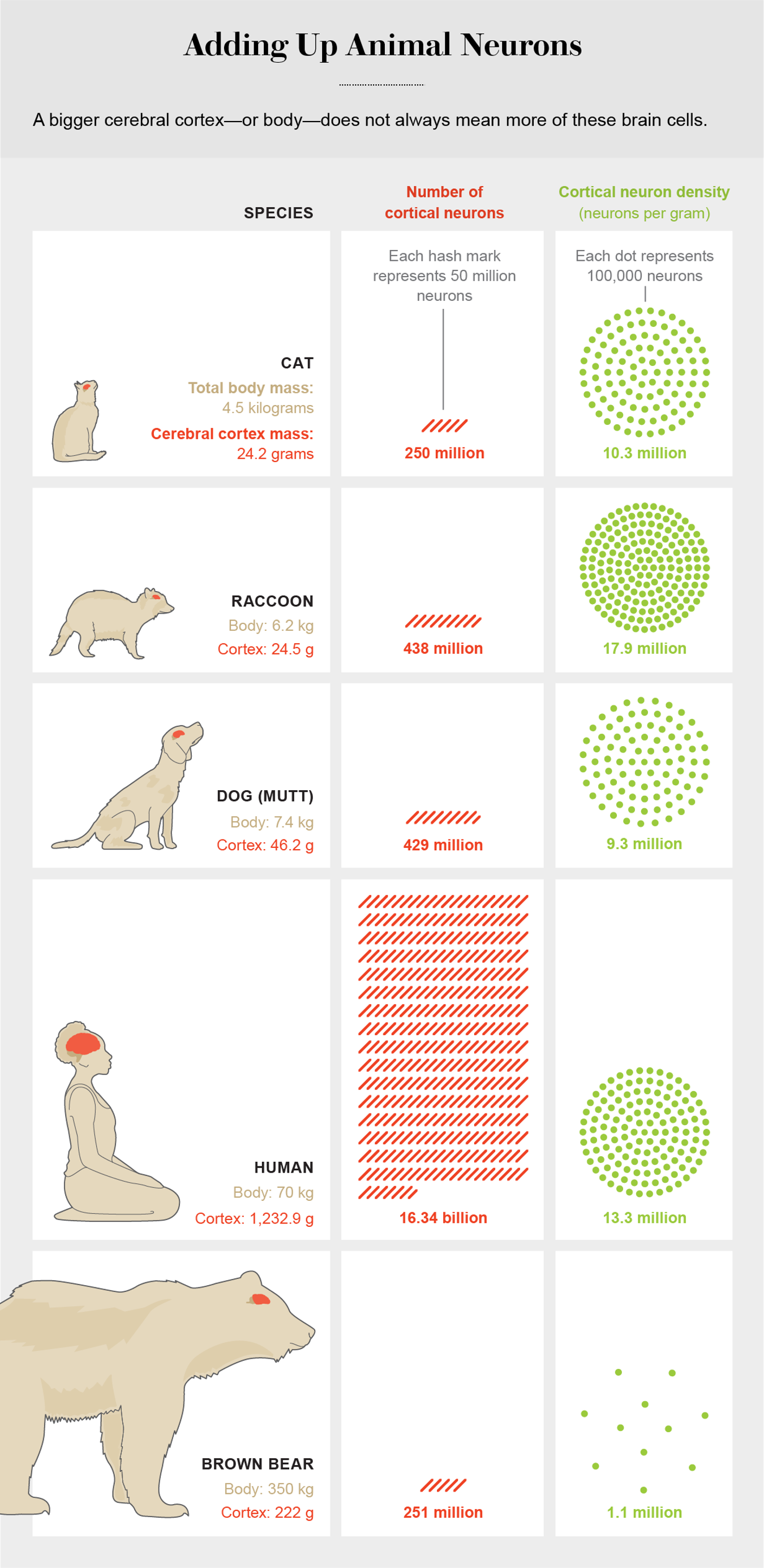
Illustration by Lucy Reading-Ikkanda; Source: “Dogs Have the Most Neurons, though Not the Largest Brain: Trade-Off between Body Mass and Number of Neurons in the Cerebral Cortex of Large Carnivoran Species,” by Débora Jardim-Messeder et al., in Frontiers in Neuroanatomy, Vol. 11, Article No. 118. Published online December 12, 2017
On supporting science journalism
If you're enjoying this article, consider supporting our award-winning journalism by subscribing. By purchasing a subscription you are helping to ensure the future of impactful stories about the discoveries and ideas shaping our world today.
To identify and count these cells, Herculano-Houzel, working with her former graduate student Débora Jardim-Messeder and their colleagues, liquefied the cortex in a laboratory version of a blender. The result looks like unfiltered apple juice, the neuroanatomist says. (“My students say that I've ruined apple juice for them.”) The scientists stirred in a probe molecule that attaches only to the nuclei of neurons in the broth, ignoring other kinds of brain cells.
They learned the raccoon has a cat-sized cortex but with almost twice as many neurons—a result that will not surprise homeowners who struggle to keep the masked creatures out of locked garbage cans. And bears turn out to be, like Winnie-the-Pooh, of very little brain: they have a cat-sized neuron count in a cortex that is bigger by 10-fold. Low neuron numbers seem to be a pattern in big carnivores, including lions. That may be because large animals need a lot of energy, and neurons are energy hogs. They require a lot of nutrients, so “we would expect animals to have as few neurons as needed, since they come with a high cost,” says anthropologist Evan MacLean, director of the Arizona Canine Cognition Center at the University of Arizona. If a brawny body can help an animal survive, it might not need as much brainpower.
As for cats and dogs, MacLean says, cortical neuron counts may not mean one can be called “smarter,” because cognition can take many forms and involve other brain areas. He does note that there is some evidence dogs hang on to information longer than cats do, which may be related to cortical capability. Herculano-Houzel, who owns two dogs and has heard from unhappy cat owners about her conclusions, emphasizes that “you should love your pet no matter how many neurons are in the cortex.”
