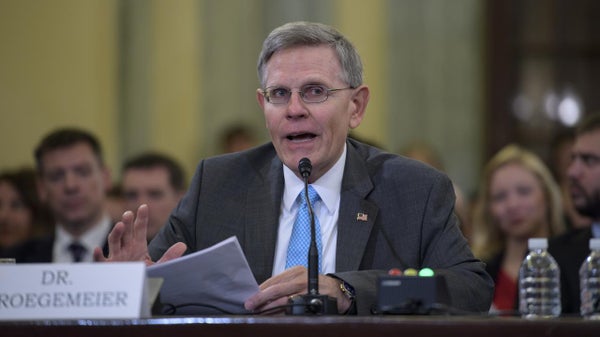
Nearly two years after he took office, US President Donald Trump has a White House science adviser in place. The Senate confirmed meteorologist Kelvin Droegemeier for the job in a voice vote on 2 January.
Droegemeier, an expert in extreme weather, will lead the White House Office of Science and Technology Policy. He is the first non-physicist to head the office since it was established in 1976, and his confirmation ends a long drought in the White House.
Trump has gone longer without a science adviser than any first-term president since at least the 1950s. His choice of Droegemeier has won generally positive reviews from science-advocacy groups.
On supporting science journalism
If you're enjoying this article, consider supporting our award-winning journalism by subscribing. By purchasing a subscription you are helping to ensure the future of impactful stories about the discoveries and ideas shaping our world today.
From 2009 until August 2018, Droegemeier was vice-president for research at the University of Oklahoma in Norman. He also served briefly as Oklahoma’s secretary of science and technology, and was a member of the National Science Board, which oversees the National Science Foundation, during the administrations of presidents George W. Bush and Barack Obama.
This article is reproduced with permission and was first published on January 3, 2018.
Subscribe to Support Independent Journalism
Great science journalism requires human expertise, time, effort and creativity. And it costs money. That’s why I and the journalists here at Scientific American hope you’ll join our community.
When you subscribe, you are supporting staff and freelance journalists who are passionate about telling science stories that are true, important and compelling. Our editors and reporters are often experts in their fields, which means they understand the nuances of big discoveries and can untangle the breakthroughs from the hype. With a subscription, you are also supporting rigorous fact-checking to ensure the words we publish are precise and accurate. And you’re supporting original illustrations, graphics and photos that bring you closer to an advanced laboratory, an ice sheet in Antarctica or a space mission in orbit. You’re helping us craft other types of high-quality journalism as well: Our newsletters are carefully written, edited and curated by staffers you have or will come to know and love. Our Science Quickly podcast is based on original reporting, collaboration with editors and scientists and exacting production.
Subscriptions keep this engine running so we can continue to deliver thoughtful, rigorous and independent science journalism to you. In an era of viral misinformation, this work is crucial. If you value what we do, I hope you’ll consider joining us as a subscriber