Don't steal my dung
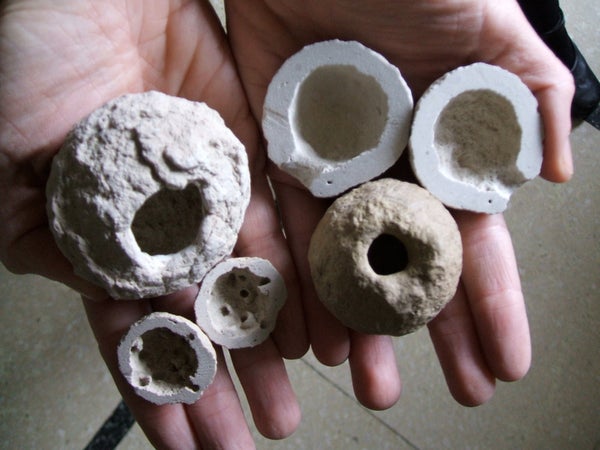
For as long as scarab beetles have been rolling dung balls, they’ve had to contend with animal bandits tunneling into their precious pellets. Paleontologists Victoria Sánchez and Jorge Genise of the Argentine Museum of Natural Sciences in Buenos Aires found at a site in Patagonia fossil dung balls that contain traces made by smaller scarab beetles, worms and bees that were apparently tapping into the nutrient-rich source.
On supporting science journalism
If you're enjoying this article, consider supporting our award-winning journalism by subscribing. By purchasing a subscription you are helping to ensure the future of impactful stories about the discoveries and ideas shaping our world today.
For as long as scarab beetles have been rolling dung balls, they’ve had to contend with animal bandits tunneling into their precious pellets. Paleontologists Victoria Sánchez and Jorge Genise of the Argentine Museum of Natural Sciences in Buenos Aires found at a site in Patagonia fossil dung balls that contain traces made by smaller scarab beetles, worms and bees that were apparently tapping into the nutrient-rich source. Dating to 45 million years ago, the tennis ball-size dung balls are the only fossilized evidence of ancient dung beetles in South America. Back in those days, the region was a stomping ground for giant ground sloths and elephantlike creatures called gomphotheres that peppered the landscape with their mega-dung. Like their modern counterparts, these beetles rolled their bounty up as a food source for their larvae, and some of these balls turned to rock. Sánchez and Genise describe their findings in this month’s issue of Palaeontology.
It’s Time to Stand Up for Science
If you enjoyed this article, I’d like to ask for your support. Scientific American has served as an advocate for science and industry for 180 years, and right now may be the most critical moment in that two-century history.
SciAm always educates and delights me, and inspires a sense of awe for our vast, beautiful universe. I hope it does that for you, too.
If you subscribe to Scientific American, you help ensure that our coverage is centered on meaningful research and discovery; that we have the resources to report on the decisions that threaten labs across the U.S.; and that we support both budding and working scientists at a time when the value of science itself too often goes unrecognized.
In return, you get essential news, captivating podcasts, brilliant infographics, can't-miss newsletters, must-watch videos, challenging games, and the science world's best writing and reporting. You can even gift someone a subscription.
There has never been a more important time for us to stand up and show why science matters. I hope you’ll support us in that mission.