
By James Regan Jamie Freed
SYDNEY, Nov 14 (Reuters) - The powerful earthquake that struck New Zealand was unusual in that a big event on one fault may have immediately triggered a big event on a second fault, experts said on Monday.
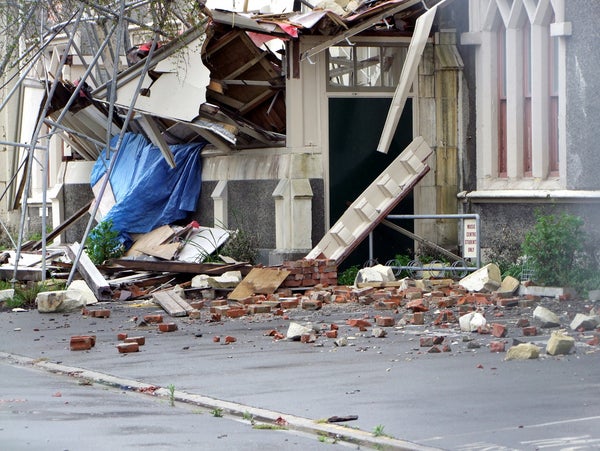
An earthquake of magnitude 7.8 pummelled central New Zealand at 12.02 a.m., killing at least two people, damaging roads and buildings and setting off hundreds of strong aftershocks.
On supporting science journalism
If you're enjoying this article, consider supporting our award-winning journalism by subscribing. By purchasing a subscription you are helping to ensure the future of impactful stories about the discoveries and ideas shaping our world today.
"When an earthquake occurs you are changing the stress field immediately, and if there was one fault that was pretty close to breaking, the energy from an earthquake can just tip it over the edge so that may have been what happened today," Adam Pascale, head of Australia's Seismology Research Centre, told Reuters.
New Zealand's GNS Science agency principal scientist Kelvin Barrowman told Radio New Zealand: "It seems like the earthquake was more like two earthquakes, but very closely spaced in time."
What remains unknown, and disconcerting, is whether the high number of aftershocks were just that, or "foreshocks" preceding another large quake.
"Let's hope this is not a foreshock of something bigger to come, which is certainly a possibility," said Dan Jaksa, senior seismologist for GeoScience in Australia.
There is recent precedent.
A 9.0 magnitude earthquake in Japan in 2011 that also triggered a tsunami and killed thousands of people was preceded by a quake of magnitude 7.3 and three magnitude-6.0 quakes.
The effects were felt around the world, from Norway's fjords to Antarctica's ice sheet. More than 5,000 aftershocks hit Japan in the following year, the largest one of magnitude 7.9.
Most powerful earthquakes occur along what are known as tectonic boundaries and Monday's quake was no exception, said Jaksa.
"It was a tectonic earthquake that was occurring on a plate boundary, which is pretty normal," he said. "This could not be predicted, but it wasn't unexpected."
One earthquake triggering another in a short period of time happens frequently on all the major tectonic plate boundaries, said Pascale, but not usually two really big ones.
As a result, New Zealand's earthquake appeared to be causing aftershocks on two separate fault lines, he said.
"What they are seeing is aftershocks in two very distinct locations and that is what is indicating, OK, we've had two earthquakes here," Pascale said.