
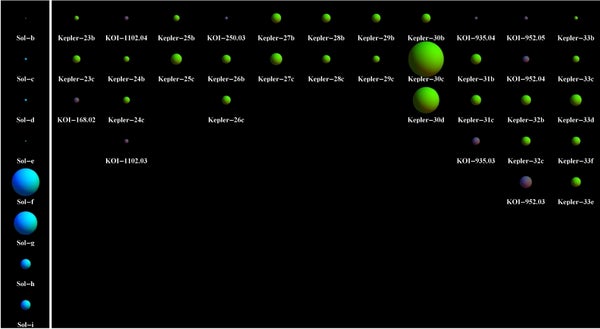
The discovery of a planet outside our solar system used to be so important that a big announcement from NASA or other professional planet-finders would usually bring news of a single planet, or perhaps a few. Not so anymore. The more we look, the more we find. Exoplanet discoveries are so plentiful these days that leading groups have started unveiling them by the dozen. That is just what scientists from NASA's Kepler mission did January 26, when the team announced the discovery of 26 newfound planets orbiting distant stars. Astronomers have now identified more than 700 exoplanets, all of them in the past two decades or so.
Kepler illustrates how new technologies have improved our ability to discover faraway worlds. It is a space-based observatory that tracks the brightness of more than 150,000 stars near the constellation Cygnus. For those stars hosting planetary systems, and for those planetary systems whose orbital plane is aligned with Kepler's line of sight, the spacecraft registers a periodic dip in starlight when an orbiting planet passes across the star's face.
Using this method, mission scientists have identified more than 2,300 planetary candidates awaiting follow-up observation and confirmation. (Some astrophysical phenomena, such as a pair of eclipsing binary stars in the background, can mimic a planetlike dimming of starlight.)
On supporting science journalism
If you're enjoying this article, consider supporting our award-winning journalism by subscribing. By purchasing a subscription you are helping to ensure the future of impactful stories about the discoveries and ideas shaping our world today.
The Kepler team confirmed most of the latest batch of planets—11 planetary systems containing up to five worlds apiece—by measuring transit timing variations, or orbital disturbances caused by the gravitational pull of planetary neighbors.
The newfound Kepler worlds are depicted as green orbs in the graphic above, with the planets of the solar system in blue for comparison. Purple dots are possible additional planets that have not yet been validated. The orbital spacing of the planets is not to scale; all 26 of the Kepler planets orbit closer to their host stars than Venus, the second-innermost planet in the solar system, does to the sun. The exoplanets range from roughly 1.5 times the diameter of Earth (marked as "Sol d" here, as it would be under exoplanetary nomenclature) to approximately 1.3 times the diameter of Jupiter (Sol f).