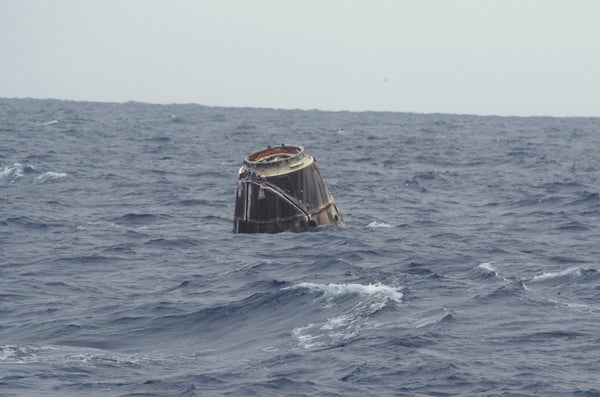
Dragon Capsule Returns from Space with Splash Landing
The SpaceX Dragon capsule parachuted to a splash landing in the Pacific Ocean on the morning of May 31, having completed its mission of cargo delivery to the International Space Station (ISS).
SpaceX/Michael Altenhofen
Join Our Community of Science Lovers!
On supporting science journalism
If you're enjoying this article, consider supporting our award-winning journalism by subscribing. By purchasing a subscription you are helping to ensure the future of impactful stories about the discoveries and ideas shaping our world today.
The SpaceX Dragon capsule parachuted to a splash landing in the Pacific Ocean on the morning of May 31, having completed its mission of cargo delivery to the International Space Station (ISS).
The Dragon was the first privately operated craft to dock with the ISS, heralding the arrival of a newcomer to the game long dominated by national space agencies such as NASA and Russia's Roscosmos. SpaceX, based in Hawthorne, Calif., and helmed by PayPal co-founder Elon Musk, is in line to make 12 cargo runs to the station in the next few years under a $1.6-billion contract with NASA.
NASA and SpaceX reported that the capsule landed near its target splashdown point, about 900 kilometers off the coast of Baja California, Mexico. The Dragon will be hauled out of the ocean by recovery boats, ferried to dry land and unloaded. It contains hardware and cargo no longer needed on the ISS, as well as science experiments that had been carried out in the station's unique microgravity environment.
It’s Time to Stand Up for Science
If you enjoyed this article, I’d like to ask for your support. Scientific American has served as an advocate for science and industry for 180 years, and right now may be the most critical moment in that two-century history.
SciAm always educates and delights me, and inspires a sense of awe for our vast, beautiful universe. I hope it does that for you, too.
If you subscribe to Scientific American, you help ensure that our coverage is centered on meaningful research and discovery; that we have the resources to report on the decisions that threaten labs across the U.S.; and that we support both budding and working scientists at a time when the value of science itself too often goes unrecognized.