
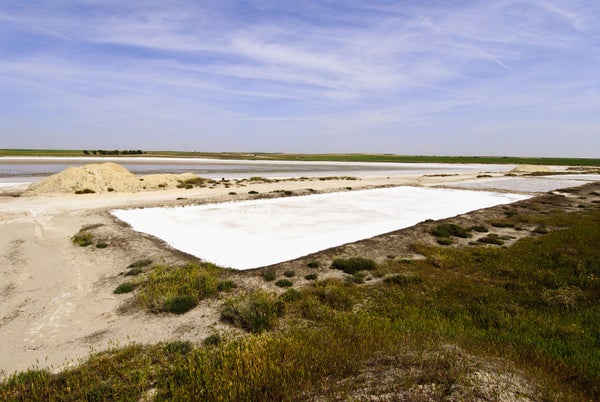
As central Spain's Tirez Lagoon dried up over 20 years, becoming entirely desiccated by 2015, its barren landscape began to evoke arid Martian plains. That resemblance, it turns out, could be useful: researchers are watching the newly dead lagoon's microbial residents to learn what could have happened to hypothetical life on Mars when its salty lakes dried up billions of years ago.
“The take-home message is that if life existed on Mars when the planet had liquid water on the surface, the global desiccation of Mars would have not necessarily implied that life disappeared for good,” says Alberto G. Fairén, an astrobiologist at the Spanish Astrobiology Center in Madrid.
Analyzing microbes in Tirez soil samples from 2002 and 2021 for a study in Scientific Reports, Fairén and his colleagues found that single-celled organisms called prokaryotes had adapted to thrive in extremely dry sediments. These results suggest microbes that developed in wetter conditions could have endured after the Red Planet dried out. The researchers also measured traces of fatty acids called lipids, which form in cell membranes, in the 2021 samples—and the team confirmed that these long-lasting molecules would be a good target in searching for signs of previous life on other planets.
On supporting science journalism
If you're enjoying this article, consider supporting our award-winning journalism by subscribing. By purchasing a subscription you are helping to ensure the future of impactful stories about the discoveries and ideas shaping our world today.
Astrobiologists often study extreme Earth environments that could resemble those of other planets. The Tirez team, however, says its new study presents the first long-term “time analog” of environmental changes on another world. Researchers had been interested in the lagoon's high salt concentration as a proxy for Jupiter's moon Europa, which some have hypothesized may hold life. But in 2020 Fairén got the idea to use the decades of lagoon data to learn about early lakes on Mars instead.
As this type of study helps researchers understand faraway worlds, it can also be useful closer to home. Time analogs raise “an interesting idea—that not only should we explore more for understanding Mars but also our own planet,” says Nathalie Cabrol, chief scientist at the SETI Institute, which focuses on the search for extraterrestrial intelligence. Cabrol, who was not involved in the study, says there is a “dire need” for research on how fast Earth's biospheres are morphing because of climate change.
Fairén's team is currently planning two new time-analog studies. First, if Spain's long dry spell ends, Fairén hopes to measure how Tirez's microbes respond to water reentering the lagoon. Second, he wants to study ecological change in polar environments where ice is melting at increasing rates to compare it with the period when Mars lost its surface ice. He's convinced such research will inspire other scientists to take advantage of changing environments for their own studies—learning more about life both on Earth and beyond.