
August 1969
Drifting Genes
“The survival and preferential multiplication of types better adapted to the environment (natural selection) is the basis of evolution. Into this process, however, enters another kind of variation that is so completely independent of natural selection that it can even promote the predominance of genes that oppose adaptation rather than favoring it. Called genetic drift, this type of variation is a random, statistical fluctuation in the frequency of a gene as it appears in a population from one generation to the next. My colleagues and I have for the past 15 years been investigating genetic drift in the populations of the cities and villages in the Parma Valley in Italy. We have examined parish books, studied marriage records in the Vatican archives, made surveys of blood types, developed mathematical theories and finally simulated some of the region's populations on a computer. We have found that genetic drift can affect evolution significantly. —Luigi Luca Cavalli-Sforza”
On supporting science journalism
If you're enjoying this article, consider supporting our award-winning journalism by subscribing. By purchasing a subscription you are helping to ensure the future of impactful stories about the discoveries and ideas shaping our world today.
Drifting Continents
“More evidence has been adduced to support the concept of continental drift. Walter Sproll and Robert S. Dietz of the Atlantic Oceanographic Laboratories of the Environmental Sciences Service Administration report they have succeeded in demonstrating that Antarctica and Australia, now separated by 2,000 miles of ocean, were once a single land mass. Concentrating on the 1,000-fathom isobath (a line around each continent at that depth), which they believe represents the true edge of each land mass, they fed their data into a computer at the University of Miami until it found the best fit between them.”
August 1919
Aerial Mail
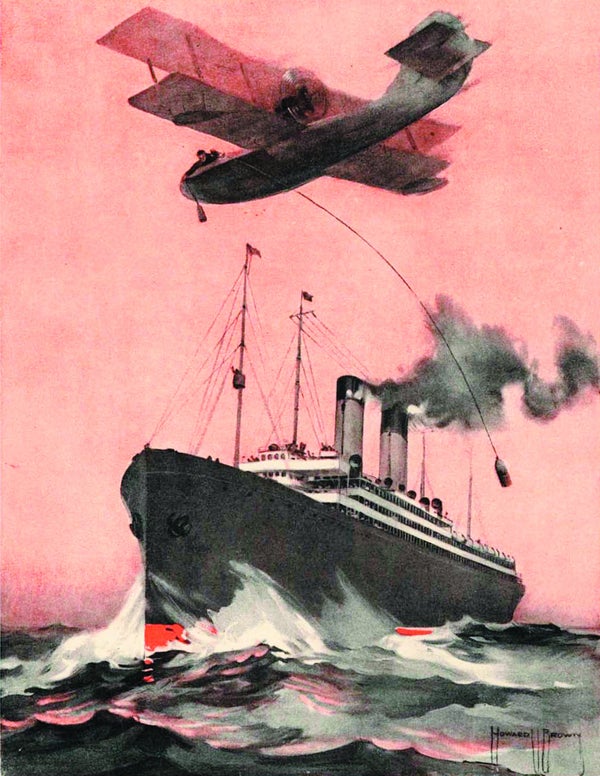
“An experiment in delivering mail to a steamer at sea is to be undertaken within a few days by C. J. Zimmerman, a skilled pilot, who will follow the steamer ‘Adriatic’ two or three hours after she has sailed for England, and overtaking her will drop a mail pouch into the sea just ahead of her bow [see illustration]. This experiment will be closely followed by the post office authorities and the steamship men.”
The delivery was successful, but the technique was perilous as compared with regular airmail delivery.
Dead Water
“Mariners who frequent the coast of Peru are familiar with a curious phenomenon that occasionally prevails there—notably in the harbor of Callao near Lima—commonly known as the ‘painter.’ The water becomes discolored and emits a nauseous smell, apparently due to sulfuretted hydrogen. The white paint of vessels becomes coated with a chocolate-colored slime. In a paper recently presented to the Geographical Society of Lima, Senor J. A. de Lavalle y Garcia concludes that the primary cause is the seasonal shift of ocean currents, at which time the warm equatorial countercurrent displaces the cool Peruvian current. The resulting change in temperature of the ocean water would, he thinks, kill quantities of plankton, and the decay of this organic matter would give rise to the phenomena observed.”
The low oxygen content of warmer El Niño waters suffocates many organisms.
August 1869
Solar Furnace
“The materials of our sun are, doubtless, capable of producing greater heat, pound for pound, than the substances usually employed by us for the same purpose. Recent researches in chemistry would seem to point to a more elementary condition of matter in the stars and nebulae than any with which we are acquainted on the earth. Who can say but that the production of our terrestrial elements was accompanied by displays of light and heat similar in intensity to those now witnessed in the sun and stars? This theory has great support in the constantly accumulating facts which the spectroscope is bringing to our attention.”
Coal Economics
“All agree that coal is absurdly, extortionately, cruelly high; but all do not agree as to the cause of present high prices, or as to how it may be cheapened. The free traders say the high price is dependent on the present tariff, while some protectionists say it is owing to extortionate freights and high prices demanded by miners. We say it is a combination of all the causes assigned. We need additional and competing lines of transit from the great beds of coal to the principal centers of trade, and we need more labor; the want of a proper labor supply being, in our opinion, one of the chief causes of trouble. This labor can be found in abundance in Asia. It only waits to be properly invited.”