
BARCELONA—Once upon a time people in the trucking industry could fantasize about increasing efficiency by having the likes of Burt Reynold’s “Bandit” character—from the 1970s chase film Smokey and the Bandit—racing around in his classic black Trans Am to fend off the cops so his partner’s 18-wheeler could ignore speed limits. But with all due respect to the Bandit, the long-haul business has a much better idea these days: self-driving big rigs that improve logistics, cost savings and road safety. And they could be on freeways even sooner than autonomous passenger cars, which have been hogging most of the limelight.
The process of automating long-haul freight trucks—the behemoths that deliver food and goods, often to places airplanes, boats and trains can’t or won’t go—is actually easier than it is for cars. This is because these trucks spend most of their road time on open highways, where there is less stopping and fewer traffic rules than in areas with pedestrians, according to Anthony Levandowski, CEO of Otto, an autonomous-trucking company he co-founded early last year. Speaking at the annual Mobile World Congress in Barcelona this week, Levandowski—a former software engineer on Google’s self-driving car project—added that despite racking up only 5.6 percent of all the miles driven in the U.S., trucks are found to be at fault for nearly 9.5 percent of the country’s driving fatalities. Many proponents of self-driving technology believe it can reduce human error, often brought on by fatigue.
Otto, which Uber bought in August 2016, also wants to enable driverless commercial trucks to operate in carefully synchronized fleets. Truck convoys are nothing new, of course, but a computerized driving system could theoretically let them safely drive even closer together, reducing the wind drag that makes engines work harder and burn more gas. Some autonomous truck makers also envision the rig’s cab becoming a sort of mobile office of the future, where a human can focus on planning and logistics rather than traffic. For obvious reasons these trucks could also stay on the road for longer stretches, giving drivers some much-needed downtime rather than keeping them at the wheel well past exhaustion.
On supporting science journalism
If you're enjoying this article, consider supporting our award-winning journalism by subscribing. By purchasing a subscription you are helping to ensure the future of impactful stories about the discoveries and ideas shaping our world today.
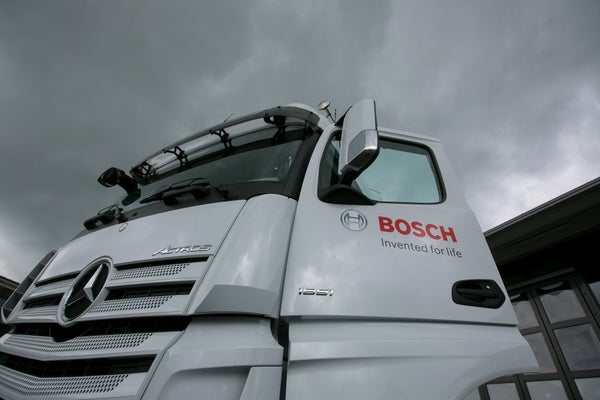
All of that suits Daniela Gerd tom Markotten just fine. Markotten, who is not involved in Levandowski’s research, lives in Stuttgart, Germany—which she calls “the capital of truck traffic.” There, she heads Digital Services and Solutions for Mercedes-Benz Trucks, a division of Daimler, AG. “Autonomous [technology] is even more important for large vehicles than it is for passenger cars,” she said during a conference session Monday at the Mobile World Congress. Mercedes is developing its own self-driving 18-wheeler—the Mercedes-Benz Future Truck 2025, featuring the company’s Highway Pilot automation system. A test version of the Future Truck debuted in July 2014 on a closed-off section of the Autobahn near Magdeburg, Germany.
Autonomous trucks will stay on a fast-track toward deployment if companies like Uber and Mercedes see a market for them and continue to invest heavily in the technology. Trucks have been a relatively slow option over land in Europe because they typically do not operate around the clock and are often delayed at borders, says Wolfgang Fengler, the World Bank’s lead economist in trade and competitiveness for eastern Europe and central Asia. Although Fengler does not claim to be an expert on autonomous vehicles, he says that if self-driving trucks can translate more hours on the road into guaranteed faster delivery, that would create “massive value” for producers and customers alike.