
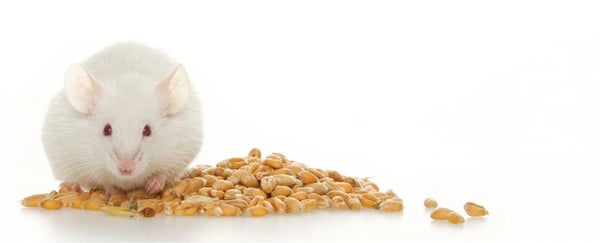
If you give a mouse a beer, he is going to want a cookie—and another, and another. If you give a person enough beer, she might find herself wolfing down a plate of greasy nachos or some other caloric snack. A study published in January in Nature Communications helps to explain why binge drinking, in both mice and humans, so often leads to binge eating even though alcohol is, itself, high in calories.
In the first part of the study, neuroscientists Craig Blomeley and Sarah Cains, both at the Francis Crick Institute Mill Hill Laboratory in London, injected mice with the equivalent of roughly two bottles of wine once a day for three consecutive days, mimicking a weekend of heavy drinking. Sure enough, the inebriated mice ate far more than sober mice in a control group.
To figure out why, the researchers then exposed thin-sliced postmortem mouse brains to alcohol and measured the resulting neural activity using fluorescent tags and electrodes. They found that ethanol exposure alters calcium exchange in the cells, causing specialized nerve cells called agouti-related protein (AgRP) neurons to fire more frequently and easily. These neurons normally fire when our body needs calories, and research has shown that activating them artificially will cause mice to chow down even when they are full.
On supporting science journalism
If you're enjoying this article, consider supporting our award-winning journalism by subscribing. By purchasing a subscription you are helping to ensure the future of impactful stories about the discoveries and ideas shaping our world today.
The study results suggest that alcohol activates AgRP neurons in the brain, giving drunk mice the munchies. The same is likely true for humans because this brain circuitry has been highly conserved across mammal species, Cains says: “I don't doubt that AgRP neurons are activated in humans, and that's why you see this effect.”
Scott Sternson, a neuroscientist at the Howard Hughes Medical Institute's Janelia Research Campus who was not involved in the research, says the work is the first to show how alcohol activates AgRP neurons and offers an “interesting and unexpected starting point” for further study.
Building on these results, Cains is interested in why alcohol seems to make us crave certain foods, such as those greasy nachos. After all, she says, “I've never had a drink and then really fancied a salad.”