
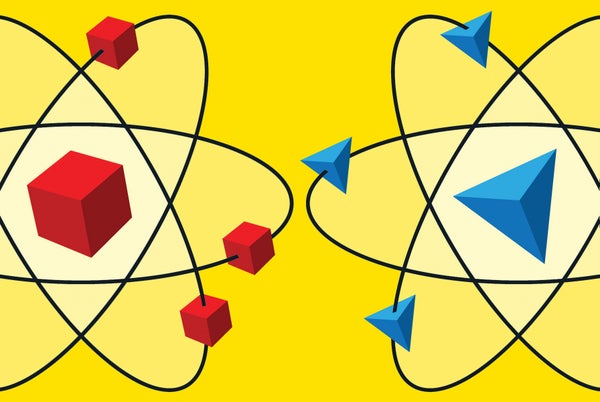
One of physicists’ foundational assumptions is that atoms aren’t unique—if two atoms have the same number of protons, neutrons and electrons, they will look and act exactly alike. This belief is fundamental to our understanding of physics and matter in the universe, and it paves the way for fields that rely on predictability, such as quantum computing. Atoms’ indistinguishability is still just an assumption, however, and scientists have a plan to put it to the test.
In a recent paper published in Physics Letters B, physicist Mark Raizen of the University of Texas at Austin proposes a series of experiments to coax out potential differences from these seemingly identical particles for the first time.
“We like to have theory and experiment march together,” Raizen says. “This question has never been tested experimentally before, so that’s what, to me, makes it interesting.”
On supporting science journalism
If you're enjoying this article, consider supporting our award-winning journalism by subscribing. By purchasing a subscription you are helping to ensure the future of impactful stories about the discoveries and ideas shaping our world today.
If atoms were distinguishable, looking at two atoms of the same type would be like looking at two cars of the same make and model, says Christian Sanner, a physicist at Colorado State University, who was not involved in the new paper. Straight off the assembly line, they might seem impossible to tell apart. But if you move closer to precisely measure the tightness of the bolts and the tiny gaps between the doors and the frame, slight differences will become more apparent.
To get extremely precise atomic measurements, Raizen proposes an experiment using a laser to cool and trap individual isotopes—variants of atoms—in an extremely precise atomic clock. This setup would let researchers detect minute differences in the isotopes’ energy levels by examining nuances in the magnetic field created by each particle’s spinning nucleus, called the nuclear magnetic moment.
The experiment builds on several decades of Raizen’s previous work. Starting when he was a postdoctoral fellow at the National Institute of Standards and Technology, he helped to develop a way for atomic clocks to cool down and trap a series of charged atoms “like pearls on a necklace.” Some of his later work focused on creating methods of controlling these trapped particles. This research led to more efficient ways of separating isotopes, an important step in many radiation-based cancer treatments and diagnostic imaging—and a key part of his plan to test for distinguishability.
“It does close a circle that started for me 30 or 35 years ago, and in that regard, it’s very gratifying and exciting to be able to combine these things which I never anticipated going back to,” Raizen says.
Even scientists who aren’t fully convinced that atoms could be unique agree that experiments testing widely accepted assumptions are an essential part of the scientific process and the long history of innovations driving the field. “That’s the attitude of modern science,” Sanner says. “Speculation is what is needed to come up with new, creative ideas, but in the end, we consider experimental results as the actual decision-maker.”