
Archaeologists have discovered two logs that were cut with stone tools almost half a million years ago beside a waterfall in central Africa. The surprising find suggests that early hominins—members of the human family tree—were expert woodworkers long before Homo sapiens evolved.
A few very ancient wooden artifacts have been unearthed before, but they have only hinted at the ability to work with tree trunks. The researchers who made the new find describe it in a study published on Wednesday in Nature. They think these logs were fixed together to form a platform above the marshy shore of the nearby Kalambo River in what is now Zambia.
“This is a disruptive discovery,” says the study’s lead author Larry Barham, an archaeologist at the University of Liverpool in England. “I never would have thought that pre-Homo sapiens would have had the capacity to plan something like this.”
On supporting science journalism
If you're enjoying this article, consider supporting our award-winning journalism by subscribing. By purchasing a subscription you are helping to ensure the future of impactful stories about the discoveries and ideas shaping our world today.
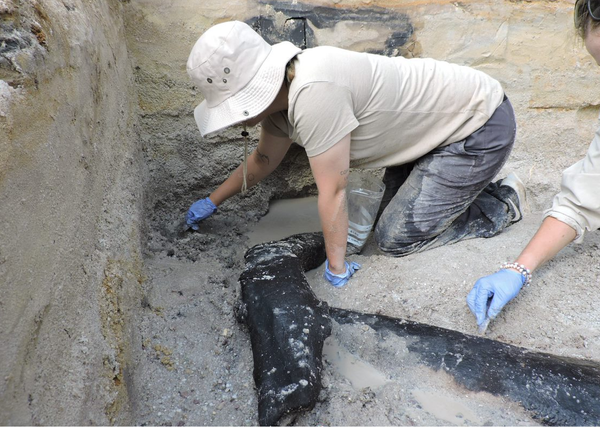
Barham’s team found the two logs in sandy sediments beside a river basin above the Kalambo Falls in 2019. The area is an archaeological treasure trove, with evidence of activity by humans and our early ancestors spanning from the Early Stone Age to nearly modern times. The ends of the two logs had been deliberately shaped to have large notches that could be fitted together like the wooden building toys Lincoln Logs. Barham thinks other logs were laid across them to form a solid platform beside the river basin, perhaps for a fishing platform or a dwelling.

The excavation team uncovering the wooden structure. Credit: Professor Larry Barham/University of Liverpool (left); Kalambo Falls, Zambia where the wood was found. Credit: Professor Geoff Duller/Aberystwyth University (right)
Wood quickly rots when exposed to air, so most wooden artifacts survive just a few years and are rare in the archaeological record. But in this case, water seeping into the sand from the river kept the logs wet and preserved them, Barham says.
Study co-author Geoff Duller, an earth scientist at Aberystwyth University in Wales, says the team tried to date the logs using radioactive carbon isotopes, which can show when trees were felled. But these logs contained only tiny levels of such isotopes, indicating they were more than 50,000 years old—the practical limit for the technique in this region.
The researchers also used a technique called optically stimulated luminescence to determine when grains of quartz and feldspar in the adjacent sediments were last exposed to sunlight. Those tests gave the age of the sediments as 476,000 years. “It’s extraordinary,” Duller says. “This site has been in textbooks, but there’s been no [precise] chronology. Now these luminescence methods give us an opportunity to provide absolute ages.”
Barham says several hominin species could have crafted these wooden objects—perhaps Homo erectus, which lived between two million and 100,000 years ago, or Homo heidelbergensis, which lived between 700,000 and 200,000 years ago.
It’s also possible the objects were made by very early members of our own species, H. sapiens, but the researchers don't think that is likely. “We like to think that anything complex and clever has got to be us, which is kind of arrogant,” Barham says, adding that the logs “predate the earliest fossils of Homo sapiens in Africa, which are about 330,000 years old.”
The woodworking abilities of early hominins had occasionally been suggested by earlier discoveries. Rough wooden spears and throwing sticks attributed to H. heidelbergensis were found in the 1990s in northern Germany. And part of a polished wooden plank, dated to more than 780,000 years ago, was unearthed in 1989 beside the Jordan River in territory disputed by Israel and Syria.
That object, too, was a rare example of wood preserved in river sediments. The new finds from the Kalambo Falls site “enrich the currently available data” from these environments, says archaeologist Naama Goren-Inbar of the Hebrew University of Jerusalem, who studied the polished plank that was found in 1989 and wasn’t involved in the new discovery of the logs. “As waterlogged sites are rare, so is our knowledge of the perishable components of the material culture.”
Archaeologist Biancamaria Aranguren, formerly at Italy’s Ministry of Culture, has studied wooden tools that were found at the Poggetti Vecchi site in Tuscany and have been attributed to early Neandertals. She says more attention should be paid to waterlogged sites that could hold well-preserved evidence of hominin woodworking. “Our knowledge about the use and the processing of wood in the most ancient periods of prehistory is comparable to the tip of an iceberg,” says Aranguren, who was not involved with the new research.
Paleoanthropologist Bruce Hardy of Kenyon College, who also wasn’t involved in the log research, has studied Neandertal string—which, he says, is evidence that this species was more technologically advanced than initially suspected. He notes that the ancient logs from Kalambo Falls seem exceptional now but only because so little wood and other organic materials from this time have survived. “Ninety percent of the material culture of the past is missing,” he says. “So when we do get the preservation, we’re rather shocked by what we find.”